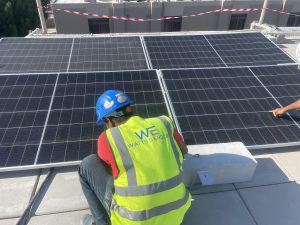
DEWA Solar Regulations in Dubai:
At Watts & Ergon, we specialise in DEWA-enrolled solar solutions and handle the entire process end-to-end.

At Watts&Ergon, we have seen firsthand how a properly designed and installed earthing system can prevent tragedies, protect valuable equipment, and ensure long-term reliability.
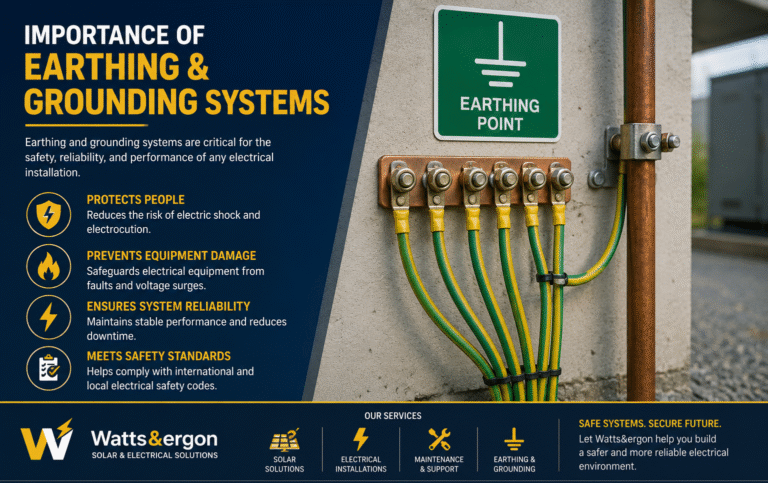
In today’s modern world, electricity powers everything from our homes and offices to large-scale industrial operations and renewable energy systems. However, with great power comes great responsibility—particularly when it comes to safety. One of the most fundamental yet often overlooked aspects of any electrical installation is the **earthing (or grounding) system**.
At Watts & Ergon , we have seen firsthand how a properly designed and installed earthing system can prevent tragedies, protect valuable equipment, and ensure long-term reliability. This comprehensive guide dives deep into the importance of earthing and grounding systems, with a special focus on the UAE context, DEWA regulations, integration with solar PV systems, and practical implementation.
The UAE’s harsh desert climate, frequent lightning activity in certain seasons, rapid urbanization, and massive adoption of solar energy make robust earthing systems not just recommended—but essential. DEWA and other authorities enforce strict standards to protect lives and property.
Earthing (commonly used in British English) and grounding (American English) refer to the process of connecting electrical equipment and installations to the earth (ground) through a low-resistance path. This connection provides a safe route for fault currents, lightning strikes, and static electricity to dissipate harmlessly into the ground.
A typical earthing system includes:
The goal is to maintain earth resistance as low as possible—ideally under 1 ohm for many applications as per DEWA guidelines.
The primary purpose of earthing is human safety. In the event of an insulation failure or fault, live current can energize metal parts of appliances or equipment. Without proper earthing, touching these parts could complete a circuit through the human body, leading to severe injury or fatality. A well-designed earthing system diverts the fault current directly to the ground, triggering protective devices like circuit breakers or RCDs (Residual Current Devices) to disconnect the supply quickly.
Fault currents that are not properly managed can cause overheating, arcing, and eventually fires. Earthing helps ensure that protective devices operate as intended, minimizing fire risks in residential villas, commercial buildings, and industrial facilities across the UAE.
Surges from lightning, switching operations, or grid disturbances can damage sensitive electronics. Earthing provides a reference potential and a path for excess voltage, significantly extending the lifespan of inverters, solar panels, servers, HVAC systems, and other equipment.
Earthing helps stabilize voltage levels and reduces electromagnetic interference (EMI), which is crucial for sensitive electronic equipment, data centers, and communication systems prevalent in the UAE.
The UAE experiences significant lightning activity. A proper earthing system is the foundation of any lightning protection setup, safely channeling massive currents into the ground without causing structural or electrical damage.
With the UAE’s aggressive push toward renewable energy, solar installations are booming. Earthing is especially critical in solar PV systems:
At Watts & Ergon, we integrate earthing seamlessly into every solar project, ensuring compliance with DEWA’s Shams Dubai requirements and international standards like IEC 60364.
Different applications require different configurations. The main types include:
Commonly used in urban areas. Subtypes: TN-S, TN-C, TN-C-S.
Independent earth electrode for the consumer installation.
Isolated neutral, often used in hospitals or critical installations.
| System Type | Key Features | Advantages | Disadvantages | Best Applications in UAE |
|---|---|---|---|---|
| TN-S | Separate neutral and protective earth conductors | High safety, low fault voltages, easy fault detection | Higher installation cost | Residential villas, commercial buildings, solar installations |
| TN-C-S (PME) | Combined PEN conductor, separated at consumer end | Cost-effective, widely used | Potential for neutral issues | General LV installations per DEWA |
| TT | Independent consumer earth electrode | Good for areas with unreliable utility earth | Requires RCDs, higher earth resistance possible | Rural or remote areas |
| IT | Isolated neutral | High continuity of supply during first fault | Complex monitoring required | Hospitals, data centers, critical infrastructure |
DEWA sets some of the strictest standards in the region:
Non-compliance can lead to project delays, rejected connections, or safety violations. Watts & Ergon, ensures full adherence to DEWA Regulations for Electrical Installations.
Effective earthing begins with proper soil resistivity testing, selection of appropriate electrodes (copper-bonded rods are popular in UAE due to corrosion resistance), and meticulous installation. Factors like sandy soil in the desert require deeper electrodes or chemical treatments to achieve low resistance.
Maintenance is equally important—annual inspections are recommended, especially after sandstorms or heavy rains.
Many believe “any metal rod in the ground” suffices, or that utility earth is enough. These misconceptions can be dangerous. Professional assessment is crucial.
Residential Villa in Dubai Hills: Installed comprehensive TN-S earthing with solar integration. Reduced earth resistance to 0.8 Ohm and protected against multiple surge events.
Commercial Warehouse in Jebel Ali: Full lightning protection + earthing system prevented equipment damage during a regional storm, saving hundreds of thousands in potential losses.
Ensure your electrical and solar systems are safely earthed by experts.
Request Free Site Assessment →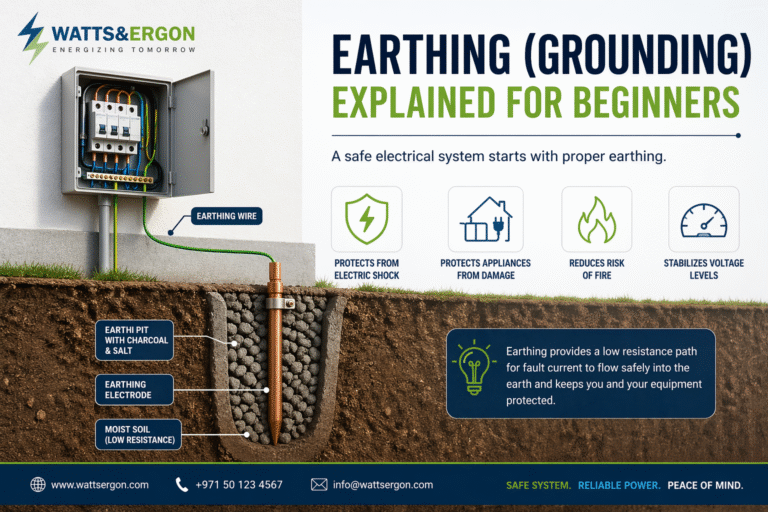
At Watts & Ergon, we specialise in DEWA-enrolled solar solutions and handle the entire process end-to-end.
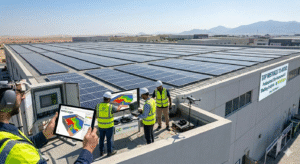
Solar panels convert light, not heat, into electricity. When they get hotter, their efficiency drops. Understanding this effect — and how to minimize it — is essential for anyone installing or operating solar systems in Dubai and the wider UAE.
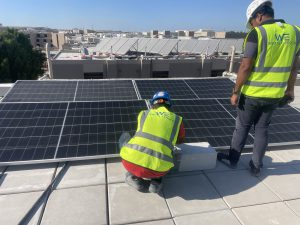
This guide breaks down the key DEWA solar regulations you need to know — system size limits, technical standards, approval process, equipment rules, and common compliance pitfalls — so you can install solar correctly the first time with a trusted DEWA-enrolled contractor like Watts&ergon.