Dubai receives abundant sunshine year-round, making it one of the best places in the world for solar energy. Through the Dubai Electricity and Water Authority’s (DEWA) Shams Dubai programmer, property owners can install rooftop solar systems, generate their own clean electricity, and significantly reduce their electricity bills.
At Watts & Ergon, , we specialize in DEWA-approved solar installations for villas, townhouses, commercial buildings, and industrial properties. Here’s a clear explanation of how solar power actually works for Dubai properties under the Shams Dubai scheme.
Shams Dubai (Arabic for “Dubai Sun”) is DEWA’s net-metering initiative. It allows any DEWA-connected property to install a solar photovoltaic (PV) system on the rooftop (or approved structures), use the electricity generated on-site, and export any surplus to the DEWA grid in exchange for bill credits.
The programmer supports Dubai’s Clean Energy Strategy 2050 and Net Zero goals while giving property owners a practical way to cut costs and increase sustainability.
A typical grid-tied solar system for Dubai properties includes:
- Solar panels – High-efficiency monocrystalline modules convert sunlight into direct current (DC) electricity.
- Inverter – Converts DC power into alternating current (AC) that matches the building’s electrical system and DEWA’s grid.
- Mounting structure – Engineered for Dubai’s wind loads and roof conditions.
- Bi-directional smart meter – Installed by DEWA to measure both electricity imported from the grid and exported to the grid.
- Monitoring system – Allows you to track generation and performance in real time.
Day-to-day operation
- During daylight hours, solar panels generate electricity.
- The building uses solar power first (self-consumption).
- Any excess electricity is automatically exported to the DEWA grid.
- At night or on cloudy days, the property draws power from the grid as usual.
- The system operates seamlessly with no interruption to your power supply.
Because Dubai’s grid is highly reliable, most residential and commercial systems do not require batteries (though hybrid options with storage are available if desired).
Net metering is the financial heart of the programmer:
- You consume solar electricity first.
- Surplus energy is exported to DEWA.
- You receive credits at the full retail electricity rate for every unit (kWh) exported.
- Credits appear on your DEWA bill and roll over indefinitely — they never expire.
- At the end of each billing cycle, you only pay for the net electricity drawn from the grid (import minus export credits).
There is no cash payment for surplus energy. Credits simply offset future consumption. This structure makes solar especially attractive in Dubai, where high summer air-conditioning demand can be partially offset by credits accumulated during milder months.
Almost any DEWA-connected property is eligible, including:
- Residential villas and townhouses
- Apartments (with owner or developer approval for common areas or individual systems where permitted)
- Commercial offices, retail, and warehouses
- Industrial facilities
- Schools, mosques, and other institutional buildings
Key requirements
- The property must have an active DEWA connection.
- Systems must be rooftop-mounted (or on existing structures/facades). Ground-mounted systems are generally not permitted under Shams Dubai.
- Only DEWA-enrolled consultants and contractors may design and install the system.
- Equipment (panels, inverters, protection devices) must be from DEWA’s approved list.
- System size is limited based on the property’s Total Connected Load (TCL) and technical review. Residential systems commonly range from 5–20 kW; commercial systems can go up to 1 MW per plot subject to approval.
Step-by-Step Process to Go Solar with DEWA
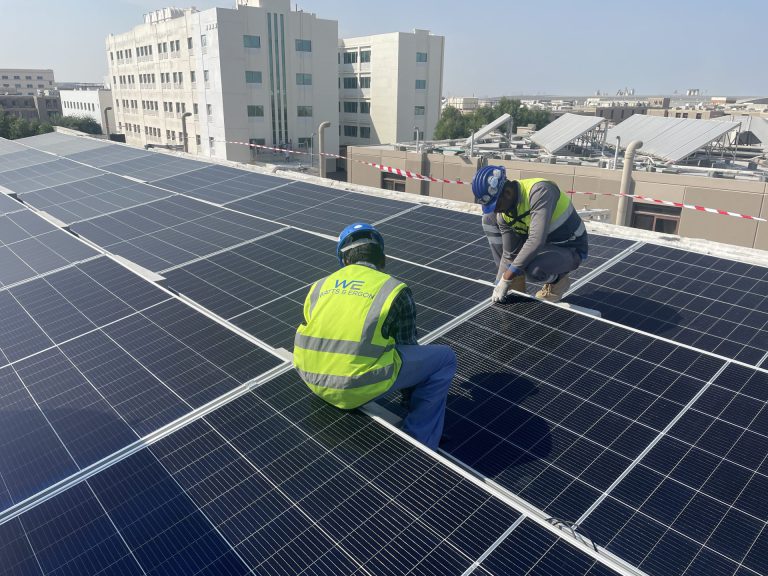
- Consultation & site assessment – A DEWA-enrolled contractor (such as Watts & Ergon) evaluates roof condition, shading, structural capacity, and your electricity consumption history.
- System design & proposal – Custom design with expected generation, savings, and return on investment.
- DEWA applications – Submission for No-Objection Certificate (NOC) and design approval through DEWA’s portal.
- Installation – Professional installation of panels, inverter, and associated equipment (typically a few days for residential systems).
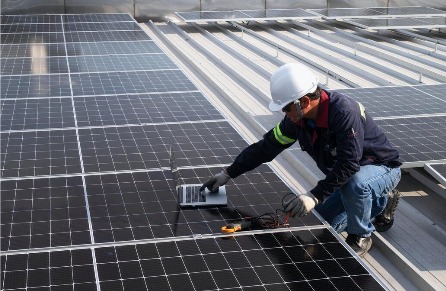
- DEWA inspection & meter installation – DEWA inspects the system and installs the bi-directional smart meter.
- Activation – The system is connected and begins generating. You start receiving credits on your DEWA bill.
The full process from survey to go-live often takes around 25–35 days for standard residential projects, depending on approvals and site conditions.
- Significant bill reduction — Many properties achieve 50–90% lower electricity bills depending on system size and consumption patterns.
- Strong return on investment — Typical payback periods of 4–6 years, followed by decades of low-cost electricity (panels are warranted for 25+ years).
- Increased property value — Solar-equipped properties are more attractive to buyers and tenants.
- Protection against tariff increases — Generating your own power hedges against future rate rises.
- Environmental impact — Reduced carbon footprint and contribution to Dubai’s sustainability targets.
- Reliable, low-maintenance operation — Grid-tied systems require minimal ongoing attention.
Why Work with Watts & Ergon?
As a DEWA-enrolled solar specialist, Watts & Ergon, handles the entire process end-to-end: accurate site assessment, compliant design, high-quality Tier-1 equipment, professional installation, DEWA approvals, and ongoing monitoring support. We focus on systems that maximise self-consumption and long-term savings while fully complying with current DEWA regulations.
Whether you own a villa in Jumeirah, a commercial building in Business Bay, or an industrial facility, we design solutions tailored to your roof space, energy usage, and financial goals.
Solar power under DEWA’s Shams Dubai programme is one of the most straightforward and financially rewarding upgrades a Dubai property owner can make. With high solar irradiance, favourable net-metering rules, and streamlined approvals, there has never been a better time to go solar.
Contact Watts & Ergon today for a free site assessment and personalised proposal. Let’s turn your rooftop into a clean energy asset that lowers bills and supports a more sustainable Dubai.