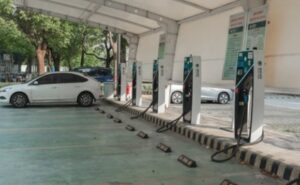
EV Charger Installation in Dubai: (2026 Guide)
At Watts & Ergon, a DEWA-approved solar and electrical contractor, we provide complete EV charger installation services for villas, apartments, offices, hotels, and commercial properties across Dubai.

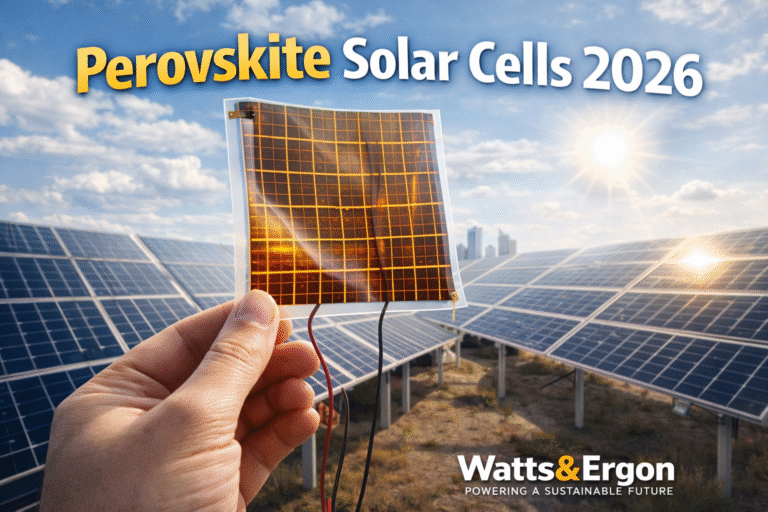
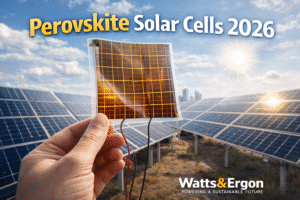
Perovskite solar panels have captured the imagination of the renewable energy world. In just over a decade, this technology has skyrocketed from laboratory curiosities with under 4% efficiency to record-breaking cells exceeding 27% for single-junction and over 35% in tandem configurations. But are they ready for prime time in the UAE market?
At Watts & Ergon, , we stay ahead of emerging solar technologies to provide our clients with the most informed recommendations for long-term performance in Dubai’s harsh climate. This in-depth guide (over 2000 words) explains everything about perovskite solar panels in 2026.
Perovskites are a class of materials with a specific crystal structure, named after the mineral perovskite (calcium titanium oxide). In photovoltaics, the term refers to synthetic hybrid organic-inorganic lead or tin halide materials that excel at absorbing sunlight and converting it into electricity.
Unlike traditional silicon, which requires high-purity wafers and energy-intensive manufacturing, perovskites can be produced using simple solution-based processes similar to printing ink on a surface. This enables low-temperature, low-cost, and potentially roll-to-roll manufacturing.
The efficiency journey of perovskite solar cells is one of the fastest in the history of photovoltaics:
| Year | Single-Junction Efficiency | Tandem (Perovskite-Silicon) | Key Milestone |
|---|---|---|---|
| 2009 | ~3.8% | – | First reported PSC |
| 2015 | ~20% | – | Rapid rise begins |
| 2023 | ~26% | ~32-33% | Commercial interest surges |
| 2026 | 26.7–27.3% | 34.85% – 35%+ | Pilot production scaling |
| Parameter | Mono PERC | TOPCon | Perovskite (2026) | Winner |
|---|---|---|---|---|
| Lab Efficiency | ~24-25% | ~26-27% | 26.7% (single) / 35% (tandem) | Perovskite Tandem |
| Commercial Module Efficiency | 19-22% | 22-25% | 16-24.5% (pilot) | TOPCon |
| Manufacturing Cost Potential | Medium | Medium | Very Low | Perovskite |
| Temperature Coefficient | -0.34%/°C | -0.29%/°C | Generally better | Perovskite / TOPCon |
| Lifespan | 25-30 years | 25-30+ years | 5-15 years (improving) | Silicon |
| Weight & Flexibility | Heavy & Rigid | Heavy & Rigid | Light & Flexible options | Perovskite |
Stability has been the Achilles’ heel of perovskite technology. In 2026, significant progress includes:
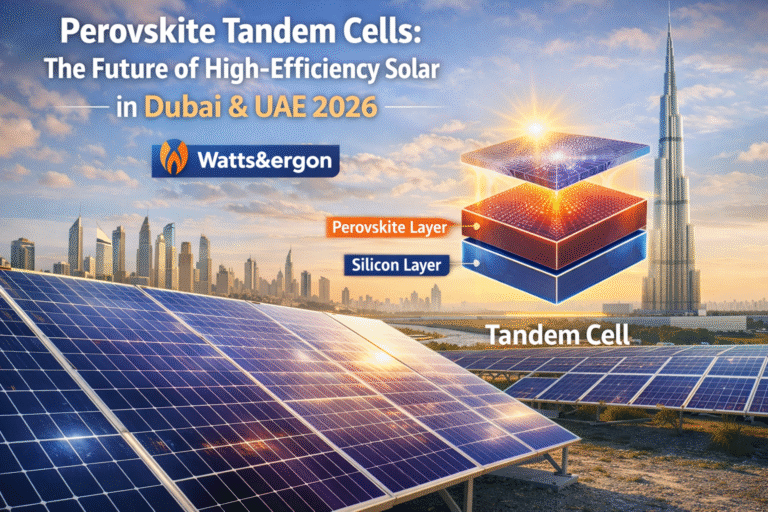
Dubai’s extreme heat, dust, and high irradiance present both opportunities and challenges for perovskite technology. Better temperature coefficients could be advantageous, but humidity and dust require robust encapsulation. At Watts & Ergon, we believe tandem perovskite-silicon modules could become excellent options for space-constrained rooftops once stability reaches 20+ year warranties.
Perovskite modules have the potential to drop below $0.20/W at scale. Combined with higher efficiency, this could . dramatically lower LCOE (Levelized Cost of Energy) compared to current TOPCon systems.
Pilot-scale production is underway. Companies like Oxford PV, LONGi, Hanwha Qcells, and UtmoLight are leading the charge. Full mass adoption is expected between 2027–2030, but early adopters can access pilot products now.
While perovskite technology matures, Watts & Ergon continues to deliver proven TOPCon and high-efficiency silicon solutions with battery storage that work reliably today.
Get a FREE Site Assessment and Future-Proof Recommendation
At Watts & Ergon, a DEWA-approved solar and electrical contractor, we provide complete EV charger installation services for villas, apartments, offices, hotels, and commercial properties across Dubai.
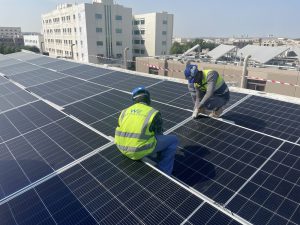
At Watts & Ergon, a DEWA-approved and ISO-certified solar EPC contractor, we specialize in designing and installing high-performance rooftop solar systems tailored specifically for warehouses, distribution centers, and industrial facilities across Dubai and the UAE.
At Watts & Ergon, a DEWA-enrolled, ISO-certified solar EPC contractor, we design and install systems specifically engineered for UAE conditions. Here’s what actually works in 2026.