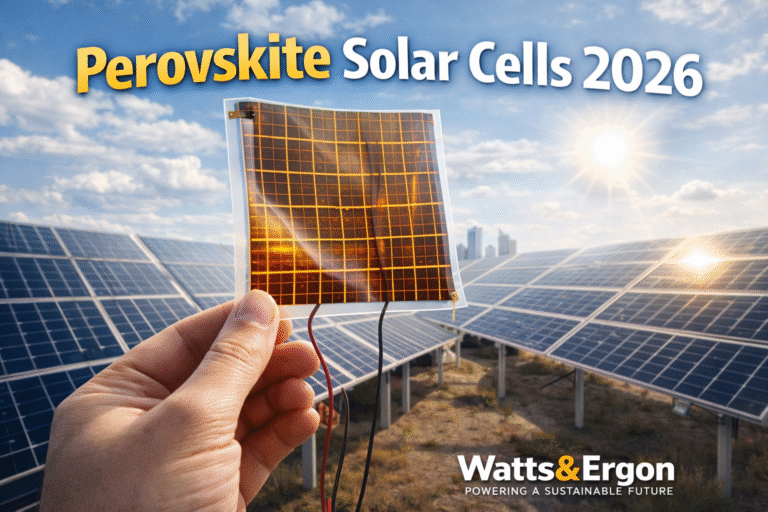
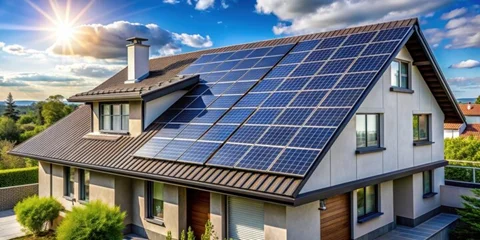
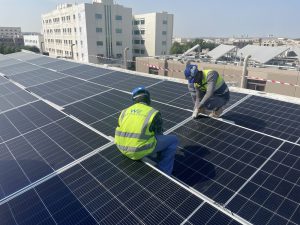
Perovskite solar cells are widely regarded as the most promising next-generation solar technology. In 2026, they are moving rapidly from laboratory breakthroughs to early commercial deployment, especially in tandem configurations with silicon. With efficiencies already exceeding 35% in lab tandems and commercial modules approaching 25-29%, perovskites could dramatically reduce costs and increase energy output per square meter — perfect for space-constrained rooftops in Dubai and the UAE.Watts & Ergon,
What Are Perovskite Solar Cells?
Perovskites are synthetic materials with a unique crystal structure that excels at absorbing sunlight. They can be manufactured as thin films using low-cost, scalable processes like printing or coating, making them lighter, more flexible, and potentially much cheaper than traditional silicon panels.
Perovskite vs Traditional Silicon Solar Panels (2026 Comparison)
| Feature |
Perovskite / Tandem (2026) |
Traditional Silicon (TOPCon / HJT) |
Winner |
| Lab Efficiency Record |
35.0% (tandem) |
~27% |
Perovskite Tandem |
| Commercial Module Efficiency |
24–29% (early tandem) |
20–24% |
Perovskite Tandem |
| Manufacturing Cost Potential |
Lower (thin-film process) |
Higher |
Perovskite |
| Weight & Flexibility |
Lightweight & flexible options |
Heavier & rigid |
Perovskite |
| Proven Lifespan |
Improving (10–25+ years target) |
25–30+ years |
Silicon (current) |
| Best For UAE Climate |
High potential (with encapsulation) |
Proven heat tolerance |
Both (tandem future) |
Key Milestones & Records in 2025–2026
| Category |
Efficiency / Achievement |
Company / Lab |
Status |
| Single-Junction Perovskite |
27.3% |
NREL certified |
Lab Record |
| Perovskite-Silicon Tandem |
35.0% |
LONGi Solar |
World Record |
| Large-Area Module |
18.1% on 0.72 m² |
UtmoLight |
Commercial Pilot |
| Commercial Tandem Module |
24.5–28.6% |
Oxford PV / Qcells |
Shipping in 2025–2026 |
Advantages of Perovskite Solar Technology for UAE
- Higher Efficiency: More power from the same rooftop area — ideal for Dubai villas and high-rises.
- Lower Production Costs: Potentially 30–50% cheaper manufacturing in the future.
- Lightweight & Versatile: Suitable for building-integrated PV (BIPV), facades, and curved surfaces.
- Better Low-Light Performance: Generates more energy during early mornings, evenings, and cloudy days.
- Tunable Bandgap: Perfect for tandem layers that capture different parts of the solar spectrum.
Challenges & Stability Progress in 2026
The main historical hurdle has been long-term stability under heat, humidity, and UV light. Significant breakthroughs in encapsulation, additives, and self-healing materials mean many manufacturers now target 20–25+ year warranties. Early commercial tandem modules are already passing IEC certifications and showing promising field results.
Commercialization Timeline (2026–2030)
| Year |
Milestone |
Expected Impact |
| 2025–2026 |
First commercial tandem shipments (Oxford PV, UtmoLight, Qcells) |
Pilot projects & utility-scale demos |
| 2027–2028 |
GW-scale production lines |
Prices drop significantly |
| 2029–2030 |
Mass residential & commercial adoption |
Payback periods potentially under 4 years in UAE |
Stay Ahead with Next-Generation Solar in Dubai
While perovskite technology is rapidly advancing, today’s premium bifacial and TOPCon panels from Watts & Ergon, already deliver excellent 4–7 year payback under Shams Dubai net metering.
We are actively tracking perovskite developments and will be among the first to offer certified next-gen solutions as soon as they meet DEWA standards and long-term reliability requirements.
Contact Watts & Ergon, today for a free consultation on current high-performance solar systems and future-ready planning for your villa, apartment, or commercial project.