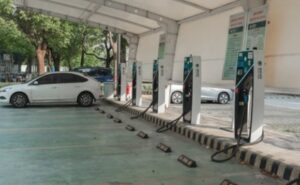
EV Charger Installation in Dubai: (2026 Guide)
At Watts & Ergon, a DEWA-approved solar and electrical contractor, we provide complete EV charger installation services for villas, apartments, offices, hotels, and commercial properties across Dubai.

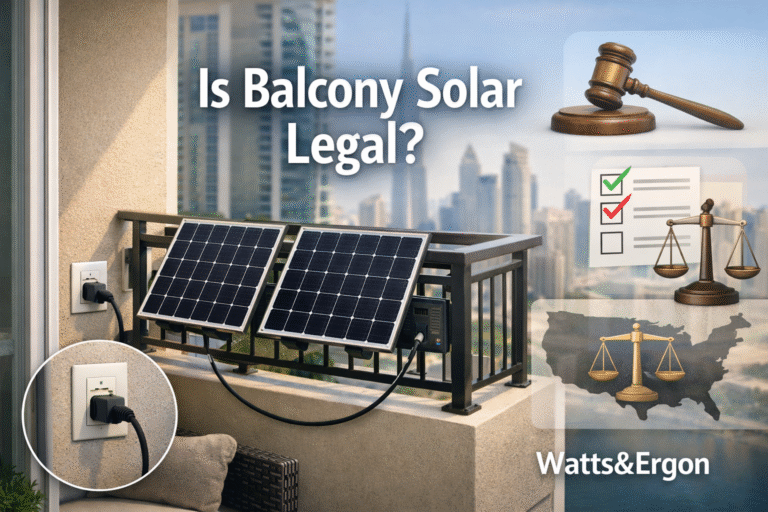
In 2026, balcony solar plug-in systems (also called plug-and-play solar or balcony solar kits) are one of the fastest-growing clean energy solutions for homeowners and renters. These compact solar PV panel setups connect directly to a standard household outlet, allowing you to generate your own electricity from your balcony, terrace, or patio without complex rooftop installations.
But the most common question we receive at our online solar store remains: Is a balcony solar plug-in system legal in your state? The answer depends on where you live, as rules vary significantly across the United States and even in the UAE.
As a leading provider of premium solar PV panels, lithium batteries, solar inverters for industrial and residential use, electric wires, tools, electric boxes, and full professional installation services, we help customers navigate these regulations every day. Our online store makes it easy to buy complete systems with fast shipping, while our expert installation team ensures full compliance.
A balcony solar plug-in system consists of 1–4 high-efficiency solar PV panels (typically 300-400W each), a microinverter, mounting hardware, and a simple plug that connects directly to your 120V wall outlet. The microinverter converts DC power from the panels into usable AC power for your home appliances, with any excess potentially feeding back to the grid in approved areas.
Key benefits include:
Our premium solar PV panels are designed for partial shade conditions common on balconies, while our lithium batteries provide backup power during cloudy days or outages. All components are available in our online store, along with matching solar inverters, durable wires, professional-grade tools, and weatherproof electric boxes.
In 2026, with electricity prices continuing to rise, balcony solar offers an accessible path to energy independence. Our installation team has successfully deployed hundreds of systems across different states and in the UAE, ensuring every setup is safe, legal, and optimized for maximum performance.
Electricity regulation in the US is handled primarily at the state and utility level. Traditional interconnection rules were designed for large rooftop solar systems, making small plug-in balcony systems fall into a regulatory gray area in many places. Utilities worry about grid safety, backfeeding during outages, and revenue loss, which creates this patchwork of rules.
Factors affecting legality:
Our expert team stays updated on all changes and helps customers choose the right combination of solar PV panels, lithium batteries, and inverters that comply with local codes.
| State | Legal Status (April 2026) | Max Size Without Full Interconnection | Key Requirements | Recommended Action |
|---|---|---|---|---|
| Utah | Fully Legal | Up to 1,200W | UL 3700 certified only | Plug & play with our kits |
| Maine | Fully Legal | Up to 1,200W | Dedicated circuit for larger kits | Use our installation team |
| Virginia | Pending Signature | Up to 1,000W | Expected UL 3700 + simple notification | Contact us for updates |
| California | Advancing (SB 868) | 800–1,200W | Interconnection likely simplified | Hybrid systems with lithium batteries |
| New York | Bill Introduced | Pending | Utility approval currently required | Professional installation recommended |
| Texas, Florida, Illinois | Gray Area / Pending | Varies | Utility-by-utility rules | Free compliance consultation |
| All Other States | Case-by-Case | Usually requires agreement | UL 3700 strongly recommended | Shop certified products online |
This table provides the most current snapshot as of April 2026. Laws are changing rapidly — our team monitors every bill and provides free updates when you contact us or shop at our online store. In states where full plug-and-play is not yet legal, we recommend starting with solar PV panels paired with lithium battery storage and grid-tied solar inverters to minimize issues.
UL 3700 is the new gold standard published in late 2025 specifically for plug-in solar photovoltaic systems. It ensures protection against electrical shocks, fire hazards, grid instability, and improper power flow.
Critical safety features required by UL 3700:
All solar PV panels, microinverters, and lithium batteries we sell in our online store meet or exceed UL 3700 and related standards. Our installation team uses only certified wires, tools, and electric boxes to guarantee complete safety and code compliance.
1. Check your local laws and utility rules using our free consultation service.
2. Select UL-certified solar PV panels and matching components from our online store.
3. Evaluate your balcony sunlight and outlet capacity.
4. Purchase a complete kit including lithium batteries (optional), solar inverters, wires, tools, and electric boxes.
5. Install with our professional team or follow certified DIY instructions.
6. Register with your utility where required.
7. Monitor performance via smartphone apps.
Our full-service installation team handles permitting, mounting, wiring, testing, and commissioning across the US and UAE, ensuring every system is 100% legal and optimized.
In Dubai, DEWA’s Shams Dubai program governs small-scale solar. Direct plug-in without approval is not permitted, but our team can secure fast approvals for compliant systems using certified solar PV panels, lithium batteries, and solar inverters. We provide complete turnkey solutions including all electric products and professional installation.
We are your one-stop online solar store offering:
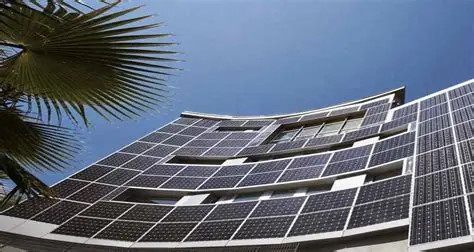
At Watts & Ergon, a DEWA-approved solar and electrical contractor, we provide complete EV charger installation services for villas, apartments, offices, hotels, and commercial properties across Dubai.
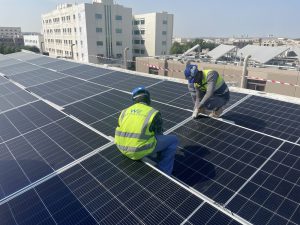
At Watts & Ergon, a DEWA-approved and ISO-certified solar EPC contractor, we specialize in designing and installing high-performance rooftop solar systems tailored specifically for warehouses, distribution centers, and industrial facilities across Dubai and the UAE.
At Watts & Ergon, a DEWA-enrolled, ISO-certified solar EPC contractor, we design and install systems specifically engineered for UAE conditions. Here’s what actually works in 2026.