In Dubai and across the UAE, solar installations face extreme heat, dust, and humidity that can silently degrade performance. A solar panel may look perfect from the ground, yet produce 20-30% less power due to hidden faults. This is where **thermal imaging** becomes a game-changer.
At Watts & Ergon, we specialize in advanced thermal imaging inspections for residential, commercial, and industrial solar systems. Our DEWA-approved technicians use high-resolution infrared cameras to detect issues early, preventing energy loss and expensive repairs.
This comprehensive 2026 guide explains exactly how thermal imaging works, the common faults it reveals, real-world benefits, inspection costs in the UAE, and why regular thermal scans are essential for protecting your solar investment. Discover how proactive detection can deliver significant savings and higher returns.
Key Fact 2026: Thermal imaging can detect faults reducing panel efficiency by up to 30% before they become visible or cause major downtime. Early intervention often pays for the inspection within months through increased energy production.
How Thermal Imaging Works for Solar Panel Inspection
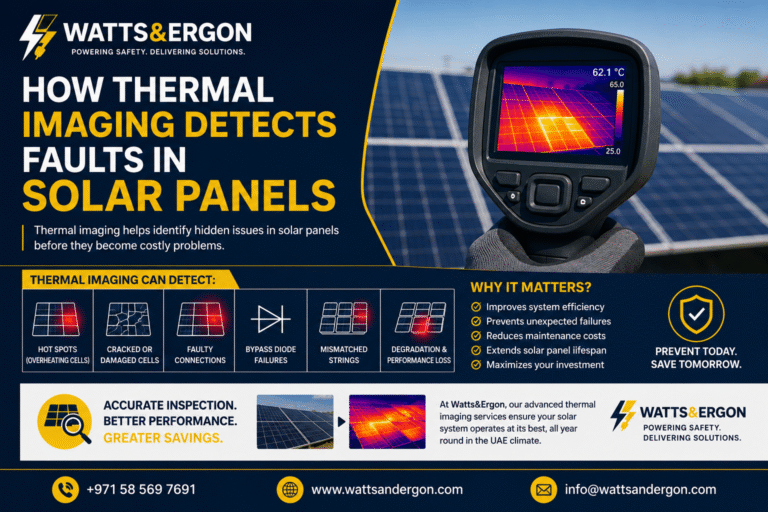
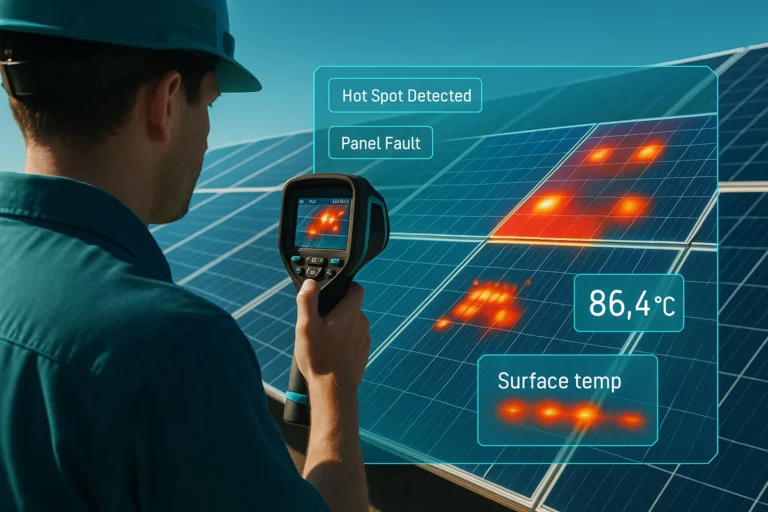
Thermal imaging (thermography) uses infrared cameras to capture heat signatures emitted by objects. Solar panels under load convert sunlight into electricity, but faults create resistance that generates excess heat. These appear as “hotspots” or irregular patterns on a thermal image.
Modern radiometric cameras (640×512 resolution or higher with <50 mK sensitivity) provide precise temperature readings. Inspections are typically done during peak sunlight when panels are operating at full capacity.
1. Hotspots from Cell Damage or Cracks
Individual cells overheat due to cracks, manufacturing defects, or physical damage. A single hotspot can reduce string output and risk fire in severe cases.
2. Bypass Diode Failures
When a diode fails, an entire substring (often 1/3 of the panel) heats up uniformly. This is one of the most common and detectable issues.
3. Potential Induced Degradation (PID)
Shows as edge-to-center heating patterns, especially on negative poles of strings. Common in humid or high-voltage systems.
4. Connection and Junction Box Issues
Loose terminals or corroded connections create intense localized heat.
5. Delamination and Soiling Patterns
Moisture ingress or heavy dust creates uneven cooling/heating areas.
6. Shading and Mismatch Problems
Persistent shading from nearby structures or vegetation causes chronic underperformance visible as cooler or hotter zones.
Thermal Imaging vs Other Inspection Methods
| Method |
Detection Capability |
Speed |
Cost |
Best Use |
| Visual Inspection |
Surface damage only |
Fast |
Low |
Basic checks |
| Thermal Imaging |
Internal electrical faults |
Very Fast (drone) |
Medium |
Performance issues |
| Electroluminescence (EL) |
Micro-cracks |
Slow |
High |
Manufacturing QA |
| I-V Curve Testing |
Overall performance |
Medium |
Medium |
Commissioning |
Benefits of Thermal Imaging for Solar Systems in UAE
- Early Fault Detection: Identify issues before they cause 10-30% production loss.
- Fire Prevention: Hotspots exceeding 150°C pose serious risks in Dubai heat.
- Non-Contact & Safe: Inspect while system operates at full load.
- Fast Coverage: Drone-based scans cover thousands of panels per day.
- ROI Boost: Maintain peak efficiency for faster payback on solar investment.
- Compliance & Warranty: Documented reports support manufacturer claims.
Cost of Thermal Imaging Inspections in Dubai & UAE (2026)
| System Size |
Inspection Type |
Cost Range (AED) |
Frequency Recommended |
| 5-10 kW (Villa) |
Handheld + Report |
1,200 – 2,500 |
Annually |
| 20-50 kW (Commercial) |
Drone + Detailed Analysis |
3,500 – 8,000 |
Every 6-12 months |
| 100 kW+ |
Full Drone + AI Processing |
10,000 – 25,000+ |
Bi-annual |
ROI and Savings from Thermal Imaging
| Scenario |
Annual Energy Loss Without Inspection |
Savings After Fixing Faults |
Payback on Inspection |
| 10 kW System |
AED 1,500 – 4,000 |
15-25% recovery |
3-6 months |
| 50 kW System |
AED 8,000 – 20,000 |
10-30% recovery |
4-8 months |
Step-by-Step Thermal Imaging Inspection Process at Watts & Ergon
- Pre-inspection planning and safety assessment
- Drone or handheld thermal scanning under full load
- Real-time analysis of anomalies
- Detailed report with temperature deltas and recommendations
- Repair coordination and follow-up verification scan
Case 1: Dubai Hills Villa (8 kW System) — Thermal scan revealed multiple bypass diode failures and dust-induced hotspots. After cleaning and diode replacement, production increased by 28%, adding over AED 2,800 in annual savings.
Case 2: Jebel Ali Warehouse (120 kW) — Drone inspection identified PID in several strings. Targeted panel replacements restored full output, preventing AED 18,000 yearly losses.
Best Practices for Solar Panel Maintenance in Dubai Climate
- Combine thermal imaging with annual electrical maintenance
- Schedule inspections before peak summer months
- Integrate with smart monitoring systems
- Address shading and soiling promptly
We offer DEWA-compliant, drone-enabled thermal inspections using the latest radiometric cameras. Our team combines solar expertise with preventive maintenance packages tailored to UAE conditions.