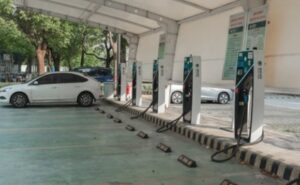
EV Charger Installation in Dubai: (2026 Guide)
At Watts & Ergon, a DEWA-approved solar and electrical contractor, we provide complete EV charger installation services for villas, apartments, offices, hotels, and commercial properties across Dubai.

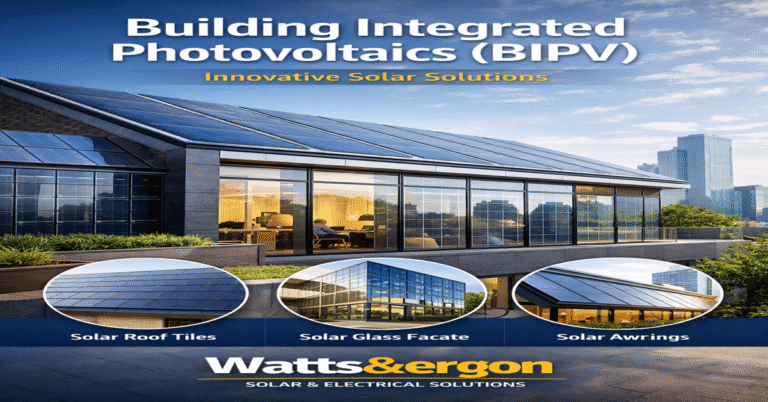
In 2026, BIPV is no longer a futuristic concept. It’s a practical, high-performance solution transforming villas, commercial towers, hotels, and government buildings across Dubai and the UAE. At Watts & Ergon, we specialize in delivering premium BIPV systems that combine stunning aesthetics with exceptional energy output under DEWA’s Shams Dubai program.
Get Your Free BIPV Consultation in Dubai →BIPV refers to photovoltaic materials that replace conventional building components such as roof tiles, curtain walls, glass facades, skylights, or shading elements. Unlike traditional solar panels (BAPV) that are mounted on top of existing structures, BIPV becomes an integral part of the building envelope itself.
This dual functionality — serving as both a construction material and an electricity generator — makes BIPV the most architecturally elegant solar solution available today.
| Feature | Traditional Solar Panels (BAPV) | Building-Integrated Solar Panels (BIPV) |
|---|---|---|
| Integration | Added on top of roof/facade | Replaces building materials |
| Aesthetics | Visible, industrial look | Seamless, customizable design |
| Initial Cost | Lower ($2–3.5/W) | Higher (20–40% more) |
| Space Utilization | Mainly rooftops | Entire building envelope (facades + roof) |
| Energy Generation | Higher efficiency per m² | Lower per m² but larger surface area |
| Payback Period | 3–6 years | 6–12 years (offsets material costs) |
| Best For | Maximum output on budget | Premium architecture & net-zero goals |
These look like premium roof tiles while generating power. Ideal for villas and low-rise buildings in Dubai.
Semi-transparent or colored glass that generates electricity while allowing natural light. Perfect for high-rise commercial towers.
Transparent or semi-transparent modules that provide daylighting and power simultaneously.
Color-matched panels that blend with modern or traditional architecture.
Lightweight solutions for curved surfaces and retrofits.
| System Type | Cost per m² (AED) | Typical Payback | Best Application |
|---|---|---|---|
| BIPV Roof Tiles | 800 – 1,600 | 7–11 years | Villas & Townhouses |
| BIPV Glass Facades | 1,200 – 2,800 | 8–14 years | Commercial & Offices |
| Semi-Transparent Skylights | 1,500 – 3,500 | 9–13 years | Hotels & Malls |
While upfront costs are higher, the total cost of ownership is competitive because BIPV replaces expensive cladding, glazing, or roofing materials. In many new construction projects, the net additional cost is only 10–20% more than conventional builds.
Dubai’s aggressive net-zero ambitions, combined with DEWA’s Shams Dubai program, create a perfect environment for BIPV growth. New construction projects are increasingly specifying BIPV to meet stringent sustainability requirements.
Key drivers in the UAE:
Globally and regionally, BIPV is proving its worth. Projects in the GCC show significant cooling load reductions when using BIPV glass. In Dubai, forward-thinking developers are integrating BIPV into iconic structures to achieve both energy independence and architectural brilliance.
As a **DEWA-approved solar contractor** and experienced EPC specialist, Watts & Ergon offers:
Whether you’re building a luxury villa in Palm Jumeirah, a commercial tower in Downtown Dubai, or a sustainable warehouse — we tailor BIPV solutions to your exact vision and energy goals.
Contact the BIPV experts at Watts & Ergon for a free feasibility study, 3D visualizations, and detailed ROI projections tailored to your project.
Yes. As long as the system meets DEWA technical standards, BIPV is fully supported.
Per square meter it may generate slightly less, but the much larger usable surface area (facades + roof) often results in comparable or higher total output.
Most premium BIPV products come with 25–30 year performance warranties, matching or exceeding traditional panels.
Conclusion: Building-Integrated Solar Panels represent the next evolution of solar energy — where sustainability meets sophisticated design. In Dubai’s sunny climate and ambitious green agenda, BIPV is not just viable; it’s the smartest long-term choice for premium and forward-thinking projects.
Partner with Watts & Ergon to make your building a power-generating masterpiece.
At Watts & Ergon, a DEWA-approved solar and electrical contractor, we provide complete EV charger installation services for villas, apartments, offices, hotels, and commercial properties across Dubai.
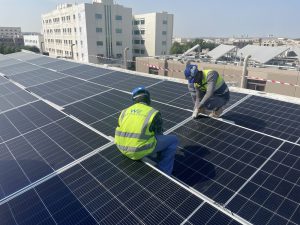
At Watts & Ergon, a DEWA-approved and ISO-certified solar EPC contractor, we specialize in designing and installing high-performance rooftop solar systems tailored specifically for warehouses, distribution centers, and industrial facilities across Dubai and the UAE.
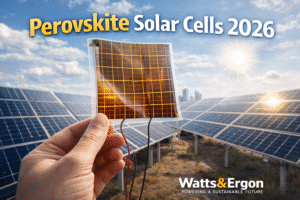
At Watts & Ergon, a DEWA-enrolled, ISO-certified solar EPC contractor, we design and install systems specifically engineered for UAE conditions. Here’s what actually works in 2026.