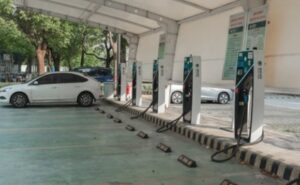
EV Charger Installation in Dubai: (2026 Guide)
At Watts & Ergon, a DEWA-approved solar and electrical contractor, we provide complete EV charger installation services for villas, apartments, offices, hotels, and commercial properties across Dubai.

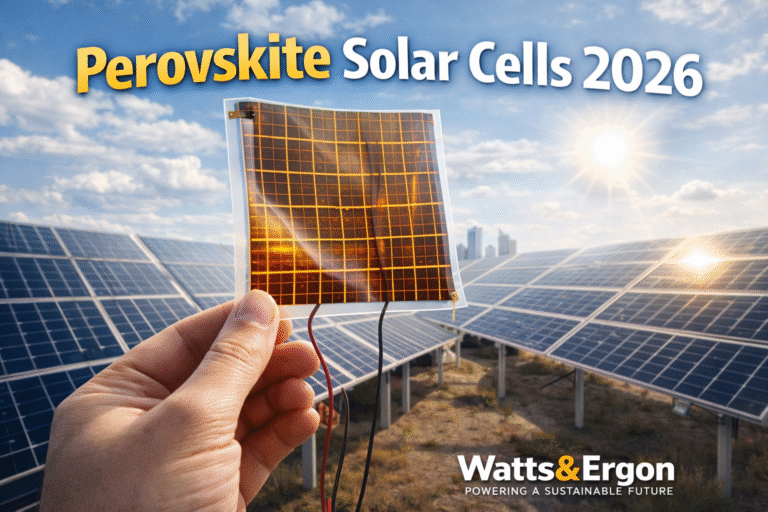
The UAE enjoys some of the highest solar irradiance in the world — over 2,000 kWh/m² annually in many areas. Yet that same climate presents serious challenges: rooftop cell temperatures regularly exceed 65–70 °C in summer, fine desert dust and sandstorms reduce output, intense UV accelerates degradation, and coastal humidity adds corrosion risk.
Choosing the wrong panels can mean 10–18 % lower real-world production and faster wear. The right ones — with low temperature coefficients, strong anti-soiling coatings, robust frames, and proven desert performance — deliver higher lifetime energy yield and faster ROI under DEWA Shams Dubai net metering.
At Watts & Ergon, a DEWA-enrolled, ISO-certified solar EPC contractor, we design and install systems specifically engineered for UAE conditions. Here’s what actually works in 2026.
| Challenge | Impact on Standard Panels | What to Look For |
|---|---|---|
| Extreme heat | 0.3–0.45 % power loss per °C above 25 °C | Temperature coefficient ≤ –0.30 %/°C |
| Dust & sandstorms | 5–15 %+ soiling losses | Anti-soiling / hydrophobic coatings, strong glass |
| High UV & thermal cycling | Faster degradation & delamination | Low annual degradation (≤ 0.45 %), quality encapsulant |
| Coastal salt & humidity | Corrosion of frames & connections | Salt-mist certified (IEC 61701), IP68 |
| High albedo (sand) | Opportunity for extra yield | Bifacial modules where suitable |
N-type technologies (TOPCon and HJT) consistently outperform older PERC modules in heat because of better temperature coefficients and lower degradation.
Typical temperature coefficient: –0.28 to –0.30 %/°C
Efficiency: 22–23.5 %+
Examples:
These offer excellent heat performance, good dust resistance, strong bankability, and competitive pricing. LONGi and JA Solar models are particularly popular for residential villas and commercial rooftops across Dubai and Abu Dhabi.
Temperature coefficient: often –0.24 to –0.26 %/°C
Examples: REC Alpha Pure-R / Pure-RX, Canadian Solar HiHero
HJT retains more power when cells hit 65–70 °C and shows very low degradation. Ideal for premium residential or sites where every extra kilowatt-hour matters. Higher upfront cost is usually offset by higher lifetime yield.
Examples: Maxeon 6 / 7
Outstanding mechanical strength, very low degradation, and industry-leading 40-year warranties in eligible markets. Excellent for high-value properties or locations with extreme wind and sand abrasion.
Especially valuable on ground-mounted or carport systems where sand or light-coloured surfaces reflect light onto the rear side. Many modern TOPCon and HJT panels are bifacial and can deliver 5–15 %+ extra energy in desert conditions.
| Technology | Temp. Coefficient | Efficiency | Typical Degradation | Best For |
|---|---|---|---|---|
| Standard PERC | –0.34 to –0.35 %/°C | 20–21.5 % | 0.55–0.7 %/yr | Budget only |
| N-type TOPCon | –0.28 to –0.30 %/°C | 22–23.5 % | 0.4–0.55 %/yr | Most homes & commercial |
| HJT | –0.24 to –0.26 %/°C | 22–23 %+ | 0.25–0.4 %/yr | Extreme heat priority |
| Premium IBC | –0.28 to –0.29 %/°C | 22–24 % | ≤ 0.25–0.3 %/yr | Longevity & warranty |
We are a Dubai-based, DEWA-enrolled solar and electrical contractor with ISO 9001, 14001 and 45001 certifications. Our team designs systems specifically for UAE heat and dust, using only proven Tier-1 modules and high-quality inverters. We handle everything: site assessment, detailed engineering, authority approvals, professional installation, and ongoing O&M.
Whether you need a villa system, commercial rooftop, industrial plant, or solar carport, we deliver reliable, high-yield installations that maximise your savings under Shams Dubai.
Contact Watts & Ergon today for a free site assessment and custom proposal tailored to UAE conditions.
Website: wattsergon.com
Email: info@wattsergon.com
Watts & Ergon – Engineering Solar Power Built for the Desert.
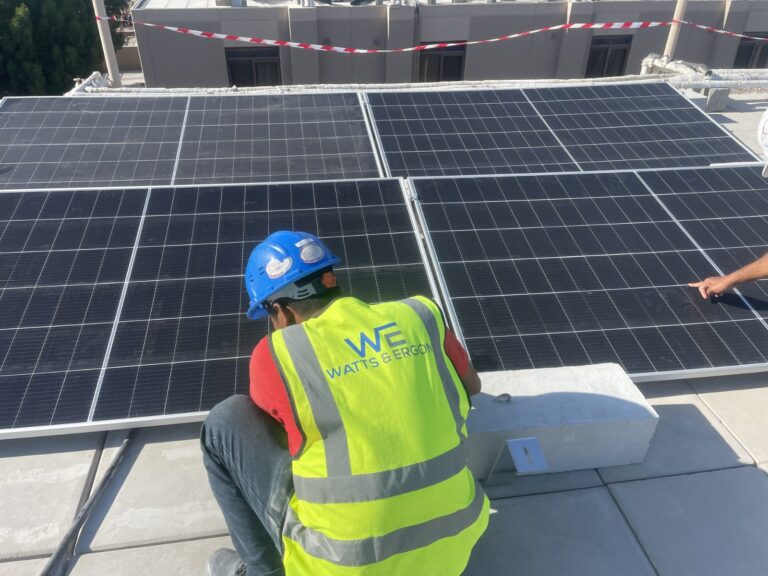
At Watts & Ergon, a DEWA-approved solar and electrical contractor, we provide complete EV charger installation services for villas, apartments, offices, hotels, and commercial properties across Dubai.
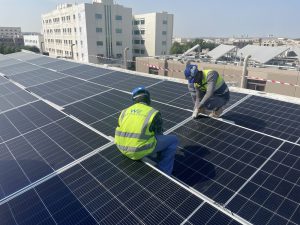
At Watts & Ergon, a DEWA-approved and ISO-certified solar EPC contractor, we specialize in designing and installing high-performance rooftop solar systems tailored specifically for warehouses, distribution centers, and industrial facilities across Dubai and the UAE.
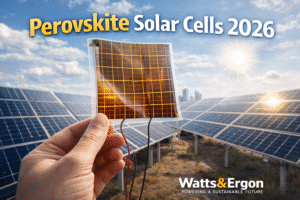
At Watts & Ergon, a DEWA-enrolled, ISO-certified solar EPC contractor, we design and install systems specifically engineered for UAE conditions. Here’s what actually works in 2026.