
Arc Flash Compliance: Safeguard Dubai Businesses
Arc flash compliance is a critical safety and legal mandate for Dubai businesses, particularly following the issuance of Dubai Law No. (2) of 2026 on Public Safety, which targets the prevention of electrical accidents in public and commercial facilities. To safeguard personnel and property, businesses must conduct a comprehensive Arc Flash Hazard Analysis—aligned with international standards like NFPA 70E and IEEE 1584—to quantify potential incident energy and define safe approach boundaries. Compliance requires the installation of durable, standardized warning labels on electrical panels, the provision of ECAS-certified Personal Protective Equipment (PPE), and documented annual safety training for all qualified staff.
Comprehensive Arc Flash Risk Assessment
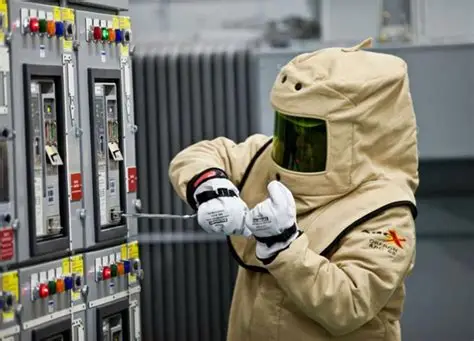
A Comprehensive Arc Flash Risk Assessment is a systematic safety study used to identify electrical hazards and protect personnel from the thermal energy released during an arc fault. Governed by standards like NFPA 70E and IEEE 1584, the assessment involves a detailed analysis of the electrical system’s short-circuit currents and the clearing times of protective devices. By calculating the Incident Energy (expressed in $cal/cm^2$), engineers determine the Arc Flash Boundary—the minimum safe distance for unprotected workers—and the specific level of Personal Protective Equipment (PPE) required for those performing energized work. The process concludes with the application of safety labels to equipment, providing clear data on hazard levels to ensure a compliant and secure working environment.
Customized Electrical Safety Programs
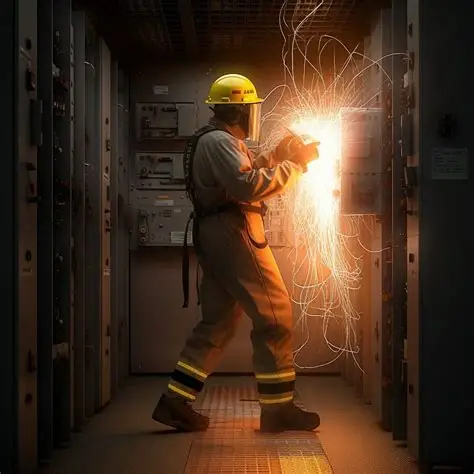
A Customized Electrical Safety Program (CESP) is a facility-specific documented framework designed to mitigate the risks of electrical shock and arc flash while ensuring compliance with standards such as NFPA 70E. Unlike a generic safety manual, a customized program is built upon the specific results of Arc Flash Risk Assessments and short-circuit studies unique to a site’s infrastructure. It establishes clear protocols for Lockout/Tagout (LOTO), defines restricted approach boundaries, and specifies the precise Personal Protective Equipment (PPE) required for various tasks based on calculated incident energy levels. By integrating a formal safety policy with practical field requirements—including preventive maintenance schedules for distribution boards and specialized training for qualified personnel—a CESP transforms theoretical safety into a measurable operational standard that significantly reduces the likelihood of workplace injuries.
Grow with Arc Flash Compliance: Ensure Safety in Dubai
In Dubai’s rapidly expanding industrial and commercial sectors, Arc Flash Compliance is no longer just a technical requirement—it is a strategic pillar for business growth and operational continuity. Achieving compliance involves a detailed alignment with both international benchmarks, such as NFPA 70E and IEEE 1584, and local mandates from the Dubai Electricity and Water Authority (DEWA) and the UAE Ministry of Human Resources and Emiratisation (MoHRE).
1. Regulatory Framework and Requirements
Compliance in Dubai is governed by a multi-layered regulatory environment designed to minimize workplace accidents:
- DEWA Regulations: Mandate that all electrical installations, including Solar PV systems and industrial distribution boards, undergo rigorous testing and inspection. For industrial facilities, independent inspections are typically required every two years to maintain safety certification.
- UAE Ministerial Decree No. 32 (1982): Obligates employers to provide a safe working environment, specifically citing protection against electrical hazards and the mandatory provision of Personal Protective Equipment (PPE).
- Green and Black Point System: DEWA utilizes a point-based system (Administrative Resolution No. 5 of 2022) where compliance earns "Green Points" that can lead to settlement privileges, while safety violations result in "Black Points" and potential legal penalties.
2. Strategic Benefits of Compliance
Beyond avoiding fines, a robust arc flash safety program acts as a catalyst for business stability:
- Operational Continuity: By identifying high-incident energy zones through short-circuit and coordination studies, businesses can prevent catastrophic equipment failures that lead to expensive, unplanned downtime.
- Lower Insurance Premiums: Insurance providers in the UAE often offer preferential rates to facilities that can demonstrate proactive risk management through up-to-date arc flash labeling and employee training records.
- Market Competitiveness: For providers of solar infrastructure and electrical supplies, demonstrating mastery of DEWA-enrolled safety standards builds trust with high-value residential and industrial clients in Dubai and the wider GCC.
3. Implementation Steps for Dubai Facilities
To ensure a compliant environment, facilities should follow a structured approach:
- Data Collection: Gather detailed infrastructure data, including transformer ratings and cable lengths, to model the electrical system accurately.
- Engineering Analysis: Perform calculations to determine Incident Energy levels and define Arc Flash Boundaries for every panel and distribution board.
- Labeling & PPE: Install NFPA 70E-compliant labels that provide technicians with immediate safety data and equip them with the correct category of arc-rated clothing.
- Continuous Maintenance: Update studies every five years or whenever significant system changes occur, such as the addition of solar inverters or industrial machinery.
FAQs
An arc flash hazard analysis assesses the risk of electrical arc flash incidents in your facility. It calculates incident energy, arc flash boundaries, and PPE requirements to ensure safety. In Dubai, Watts & Ergon’s DEWA-approved analysis complies with NFPA 70E, reducing risks and ensuring regulatory compliance.
We perform a detailed study of your electrical system, including short circuit and coordination studies, using IEEE 1584 modeling. Our team identifies hazards, calculates arc flash boundaries, and provides tailored recommendations to mitigate risks, ensuring NFPA 70E compliance for UAE facilities.
NFPA 70E is a standard for electrical safety in the workplace, outlining requirements for arc flash protection. Watts & Ergon ensures Dubai businesses meet these standards through comprehensive arc flash studies, helping avoid injuries, fines, and downtime while aligning with DEWA regulations.
A short circuit and coordination study analyzes your electrical system to determine fault currents and ensure protective devices (like circuit breakers) operate correctly. Watts & Ergon’s Dubai-based studies optimize system reliability and safety, minimizing arc flash risks.
The arc flash boundary is calculated using IEEE 1584 standards, determining the safe distance from an arc flash event where a worker could avoid severe injury. Watts & Ergon provides precise boundary calculations for UAE facilities, ensuring compliance and worker safety.
Incident energy analysis measures the thermal energy released during an arc flash, guiding PPE selection and safety measures. Watts & Ergon’s analysis helps Dubai businesses reduce arc flash liability and protect workers by identifying high-risk areas and mitigation strategies.