
Solar Panel Installation in Dubai: The Complete 2026 Guide
At Watts & Ergon, a DEWA-enrolled solar EPC contractor, we design, approve, install, and commission high-performance solar systems across Dubai and the UAE.

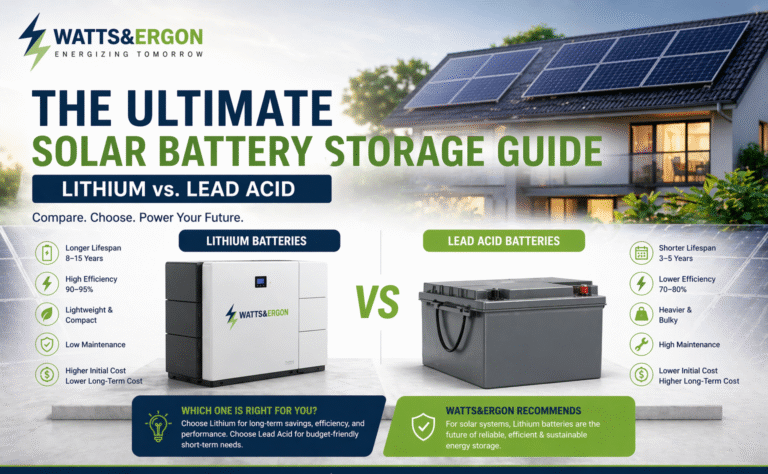
Choosing the right battery is one of the most important decisions when adding energy storage to a solar system. In the UAE’s hot climate and with DEWA’s Shams Dubai net-metering framework, the battery determines how much of your solar energy you actually use, how long the system lasts, and what your true cost of ownership will be.
Two main technologies dominate the market: traditional lead-acid batteries and modern lithium-ion batteries (especially LiFePO4 / LFP). Here’s a clear, practical comparison so you can decide which is better for your villa, commercial building, or industrial project.
| Feature | Lithium-Ion (LiFePO4) | Lead-Acid (Flooded / AGM / Gel) | Winner |
|---|---|---|---|
| Usable Depth of Discharge | 80–95% | 50% (recommended) | Lithium |
| Cycle Life | 3,000–6,000+ cycles | 300–1,000 cycles | Lithium |
| Expected Lifespan | 10–15+ years | 3–7 years | Lithium |
| Round-Trip Efficiency | 90–98% | 70–85% | Lithium |
| Weight & Size | Lightweight, compact, wall-mountable | Heavy, bulky, needs more space | Lithium |
| Maintenance | Virtually none (BMS managed) | Regular watering, cleaning, equalization (flooded) | Lithium |
| Charging Speed | Fast | Slow | Lithium |
| Upfront Cost (per kWh) | Higher ($400–$700+) | Lower ($150–$300) | Lead-Acid |
| Lifetime Cost | Significantly lower | Higher due to replacements | Lithium |
| Warranty | Typically 5–10+ years | 1–5 years | Lithium |
| Temperature Tolerance | Good (needs care below 0°C charging) | Moderate, but capacity drops in heat | Slight edge to Lead-Acid in extreme cold |
A 10 kWh lithium battery typically gives you 8–9.5 kWh of usable energy. A similarly rated lead-acid bank only safely delivers about 5 kWh. Lithium also wastes far less energy as heat (90–98% efficiency vs 70–85%). In the UAE, where every kilowatt-hour counts under net metering, this difference adds up quickly.
Lithium batteries handle daily deep cycling for a decade or more. Lead-acid batteries degrade much faster when used daily and usually need replacement every 3–7 years. Over a 10–15 year system life, you may replace a lead-acid bank multiple times.
Lead-acid wins on day-one price. Lithium wins on total cost of ownership. Because you need roughly twice the rated capacity of lead-acid to match lithium’s usable energy, and because of frequent replacements, lithium almost always becomes cheaper over the life of the system—especially for daily-cycling residential or commercial solar.
Lithium packs are compact and light. They fit neatly on walls or in tight utility rooms common in Dubai villas and commercial buildings. Lead-acid banks are heavy, need ventilation (especially flooded types), and require ongoing maintenance.
Modern LiFePO4 batteries with a proper Battery Management System (BMS) are very safe and handle the UAE’s high temperatures well when properly installed. Lead-acid is robust but produces gas during charging and must be kept upright and ventilated.
For the vast majority of solar-plus-storage projects in the UAE today, Lithium-Ion (especially LiFePO4) is the better choice. Higher upfront cost is offset by far greater usable capacity, much longer life, higher efficiency, and lower total cost of ownership. Lead-acid remains a viable short-term or budget-only option, but it is no longer the preferred technology for serious, daily-use solar systems.
At Watts & Ergon, we design and install complete DEWA-approved solar PV and battery storage systems tailored to UAE conditions. As a DEWA-enrolled contractor with ISO certifications, we help residential, commercial, and industrial clients select the optimal battery technology, size the system correctly, and deliver reliable, high-performance results.
Contact Watts & Ergon today for a free consultation and customized proposal.
Get Your Free ConsultationPowering a Sustainable Future
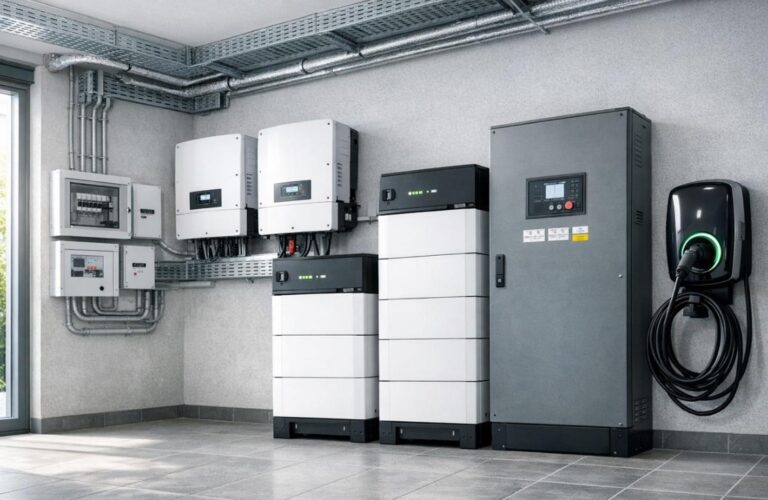
At Watts & Ergon, a DEWA-enrolled solar EPC contractor, we design, approve, install, and commission high-performance solar systems across Dubai and the UAE.

At Watts & Ergon, we design and install complete DEWA-approved solar PV and battery storage systems tailored to UAE conditions.
At Watts & Ergon, a DEWA-approved solar and electrical contractor, we deliver complete end-to-end EV charger installations for villas, apartments, offices, hotels, and commercial properties.