
Solar Panel Installation in Dubai: The Complete 2026 Guide
At Watts & Ergon, a DEWA-enrolled solar EPC contractor, we design, approve, install, and commission high-performance solar systems across Dubai and the UAE.

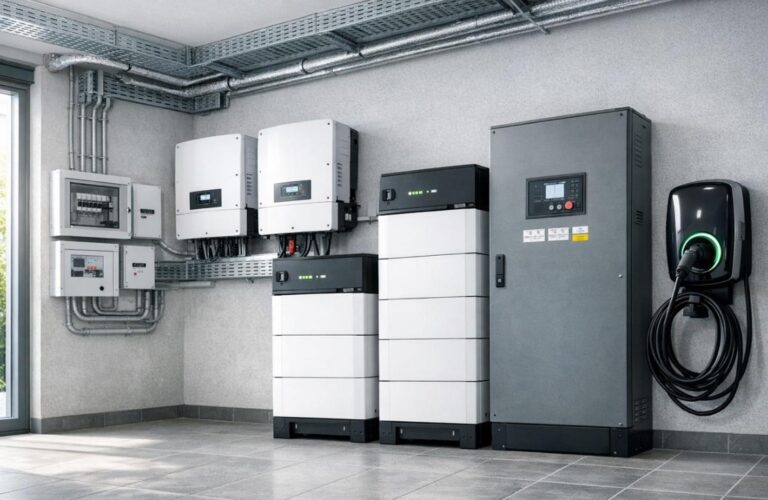
The UAE’s abundant sunshine has made solar power one of the most practical energy solutions in the region. Pairing rooftop or commercial solar panels with battery storage takes that advantage further — storing excess daytime generation for use at night, during peak tariff periods, or when the grid experiences interruptions.
At Watts & Ergon, we design and supply complete solar-plus-storage solutions across Dubai, Abu Dhabi and the wider UAE. This guide covers realistic 2025–2026 costs, the main benefits of adding storage, practical applications, and what to consider when choosing a system.
Solar panels produce most of their energy during the day. Without storage, surplus power is either exported under net-metering schemes (such as DEWA’s Shams Dubai) or curtailed. Batteries let you:
Large-scale projects reinforce the trend. Abu Dhabi’s Masdar–EWEC round-the-clock project (5.2 GW solar + 19 GWh battery storage) aims to deliver 1 GW of firm renewable power 24/7, showing that storage is now central to the UAE’s energy strategy.
Prices have fallen significantly thanks to lower lithium cell costs and greater local competition. Figures below are indicative installed or equipment ranges and vary by brand, capacity, installation complexity and emirate.
Approximate turnkey ranges for residential/villa systems:
| System Size | Approx. Cost (AED) | Notes |
|---|---|---|
| 5 kW solar + 5–10 kWh battery | 45,000–65,000 | Entry hybrid villa package |
| 7–8 kW solar + 10 kWh battery | 55,000–90,000 | Common residential size |
| 10 kW solar + 10–15 kWh battery | 70,000–120,000+ | Larger villas / light commercial |
Commercial systems are typically quoted per kWh of storage (often AED 1,500–2,500/kWh installed for mid-size projects) and benefit from economies of scale.
Key cost drivers:
Payback guidance: Grid-tied solar without batteries often pays back in 5–8 years under current tariffs and net metering. Adding storage lengthens the simple payback (commonly 7–11 years) but improves energy independence and long-term total cost of ownership because LiFePO4 batteries last 10–15 years / 6,000+ cycles with minimal maintenance.
Most common use case. A 5–15 kWh LiFePO4 system paired with a hybrid inverter covers evening lighting, air-conditioning loads, entertainment systems and overnight needs. Ideal for DEWA Shams Dubai customers who want higher self-consumption.
Warehouses, offices, retail, clinics and light manufacturing use batteries for:
Farms, desert camps, remote villas and temporary facilities where grid reliability is lower. Hybrid systems (solar + battery + optional generator) deliver high reliability.
Projects such as the Masdar–EWEC 19 GWh battery facility and storage additions at Mohammed bin Rashid Al Maktoum Solar Park demonstrate the technology at gigawatt scale for baseload renewable supply.
Always use a licensed contractor and approved equipment lists.
LiFePO4 (Lithium Iron Phosphate) is the clear recommendation for most installations:
Lead-acid remains cheaper upfront but has shorter life, higher maintenance and poorer heat performance, making it less economical over 10 years.
At Watts & Ergon we supply and install quality LiFePO4 modular and wall-mount systems sized to your load profile, roof space and budget. Every project starts with a site assessment and bill analysis so the system matches real consumption rather than generic estimates.
Battery storage makes strongest sense when:
Pure grid-tied solar (no battery) remains the fastest payback option for many Dubai homes with reliable supply and good net metering. A hybrid system adds resilience and higher self-use at a moderate extra cost.
Ready to explore a solar battery system for your villa, business or project?
Contact Watts & Ergon for a free consultation and site assessment. We will review your electricity bills, roof suitability and goals, then propose a tailored LiFePO4 hybrid solution with transparent pricing and professional installation.
Store excess solar energy today and power your tomorrow with confidence.
Watts & Ergon — Energizing Tomorrow.
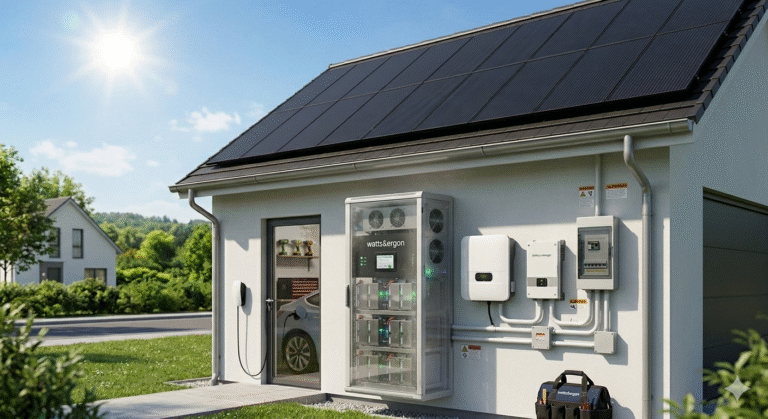
At Watts & Ergon, a DEWA-enrolled solar EPC contractor, we design, approve, install, and commission high-performance solar systems across Dubai and the UAE.

At Watts & Ergon, we design and install complete DEWA-approved solar PV and battery storage systems tailored to UAE conditions.
At Watts & Ergon, a DEWA-approved solar and electrical contractor, we deliver complete end-to-end EV charger installations for villas, apartments, offices, hotels, and commercial properties.