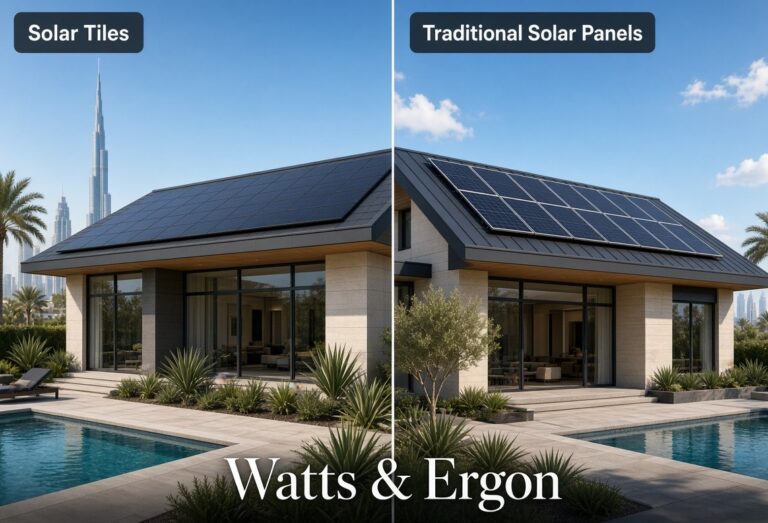
Traditional panels sit above the roof on mounting structures. While modern all-black modules look cleaner than older designs, they remain clearly visible.
Traditional solar panels are the clear winners.
Modern monocrystalline Tier-1 panels used in Dubai routinely achieve 20–23% efficiency (some premium models exceed 24%). They also benefit from better airflow underneath, which helps keep operating temperatures lower — important in Dubai’s extreme heat.
Solar tiles generally operate at 14–20% efficiency. Because they sit flush with the roof, they have less natural cooling and produce less power per square metre. You typically need more roof area to generate the same amount of electricity.
This is where the biggest difference appears.
- Traditional panels in Dubai (5–15 kW villa systems) usually cost far less per kilowatt installed and deliver payback in 4–6 years under Shams Dubai net metering.
- Solar tiles cost significantly more because you are paying for both a complete roofing system and the photovoltaic technology. Payback periods are often longer (8–12 years or more).
If your existing roof is still in good condition, traditional panels almost always offer better financial returns. Solar tiles become more competitive only when you need a full roof replacement anyway.
Traditional panels
- Mounted on existing roofs
- Minimal disruption
- Usually completed in 1–3 days
- Fully compatible with DEWA Shams Dubai procedures
Solar tiles
- Require removal of existing roofing (or installation on a new build)
- More labour-intensive and time-consuming
- Need specialised roofing + electrical expertise
- Higher complexity for waterproofing and structural integration
Both technologies work in the UAE’s high irradiance environment, but traditional panels currently have advantages:
- Better heat dissipation
- Easier cleaning (dust is a major factor in Dubai)
- Proven long-term performance data in desert conditions
- Wider availability of high-temperature-rated modules
Solar tiles must also meet strict roofing standards for wind, heat, and waterproofing — requirements that Watts & Ergon carefully evaluates on every project.
Choose traditional solar panels if you want:
- Maximum energy production and fastest payback
- Lower upfront investment
- Installation on an existing roof
- Proven, widely available technology
Choose solar tiles if you want:
- Premium aesthetics with no visible panels
- A combined new roof + solar solution
- A new-build or major renovation project
- Architectural integration as a priority
Watts & Ergon Recommendation
For the vast majority of Dubai villas in 2026, traditional high-efficiency solar panels remain the smarter financial and performance choice. They deliver excellent savings under DEWA’s Shams Dubai programme while meeting all regulatory requirements.
However, for select premium projects where design is critical, we also supply and install advanced BIPV solutions, including solar roof integration systems.
Every roof and energy profile is different. The only accurate way to compare options is through a professional site assessment and customised proposal.
Contact Watts & Ergon today for expert advice and a free consultation: