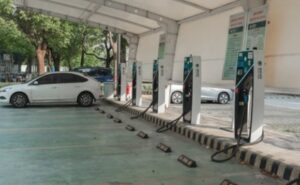
EV Charger Installation in Dubai: (2026 Guide)
At Watts & Ergon, a DEWA-approved solar and electrical contractor, we provide complete EV charger installation services for villas, apartments, offices, hotels, and commercial properties across Dubai.

At Watts & Ergon, a DEWA-approved electrical and solar contractor with ISO certification, we have designed and installed hundreds of compliant earthing systems for villas, high-rises, industrial facilities, and data centers across the UAE. This comprehensive 2026 guide covers everything you need to know.
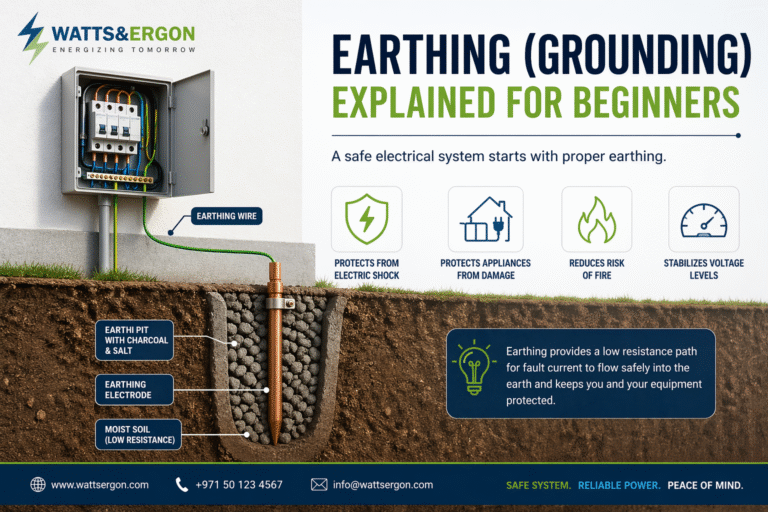
In the UAE’s extreme climate — with high temperatures, sandy soils, occasional heavy rains, and frequent lightning risks — a properly designed and installed **earthing (grounding) system** is not optional; it is a critical safety requirement. It protects lives, equipment, and buildings from electric shocks, faults, surges, and lightning strikes.
At Watts & Ergon, a DEWA-approved electrical and solar contractor with ISO certification, we have designed and installed hundreds of compliant earthing systems for villas, high-rises, industrial facilities, and data centers across the UAE. This comprehensive 2026 guide (over 2400 words) covers everything you need to know.
An earthing system provides a low-resistance path for fault currents to flow safely into the ground, preventing dangerous voltages on exposed metal parts. It also stabilizes voltage, supports surge protection, and is essential for the correct operation of protective devices like RCDs and circuit breakers.
| Type | Description | Common Use in UAE | Advantages | Limitations |
|---|---|---|---|---|
| TN-S | Separate neutral and protective earth conductors | Most commercial, industrial & high-rise buildings | High safety, low EMI | Requires dedicated PE conductor |
| TT | Local earth electrode independent of supply | Some residential & remote installations | Simple, good fault isolation | Higher earth resistance possible |
| TN-C-S (PME) | Combined PEN conductor split at building | Limited use | Cost effective | Not preferred by DEWA for most cases |
| IT | Isolated or high-impedance earthed | Hospitals, data centers (secondary systems) | Continuity during first fault | Complex monitoring required |
DEWA mandates strict compliance for all electrical installations in Dubai:
UAE soil (predominantly sand) has high resistivity (often 1,000–10,000+ Ohm-m), making it difficult to achieve low resistance.
| Soil Type | Typical Resistivity (Ohm-m) | Design Recommendation |
|---|---|---|
| Wet Clay | 10–100 | Excellent – standard rods sufficient |
| Damp Loam | 50–500 | Good conditions |
| Dry Sand | 1,000–10,000+ | Multiple deep rods + chemical enhancement |
| Rocky | 5,000+ | Horizontal grids or deep wells |
Standard earth pit: 300mm x 300mm x 3m deep or larger, filled with bentonite, charcoal, salt, or advanced earthing compounds to reduce resistivity.
Separate from power earthing per DEWA and IEC 62305. Uses air terminals, down conductors, and dedicated earth pits. Rolling Sphere Method commonly used for design.
| Test | Requirement | Method |
|---|---|---|
| Earth Electrode Resistance | ≤ 1 Ohm (DEWA) | Fall of Potential (3-point) or Clamp-on |
| Earth Continuity | ≤ 0.5 Ohm / 0.1 Ohm typical | Continuity tester |
| Soil Resistivity | Measured before design | Wenner 4-Point Method |
| Insulation Resistance | ≥ 1 MΩ | Megger test |
Annual or bi-annual testing recommended due to sandstorms, heat, and moisture variations. Visual inspection of pits and connections is essential.
As a trusted DEWA-approved contractor, Watts & Ergon provides:
Contact Watts & Ergon Today for a FREE Site Assessment
Website: wattsergon.com
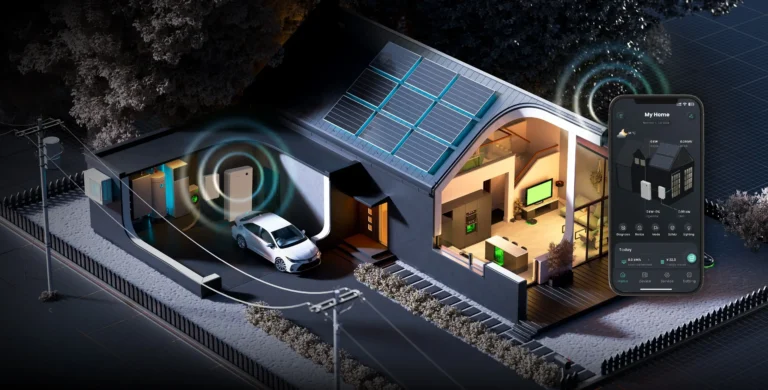
At Watts & Ergon, a DEWA-approved solar and electrical contractor, we provide complete EV charger installation services for villas, apartments, offices, hotels, and commercial properties across Dubai.
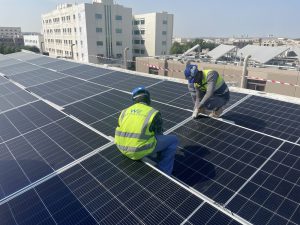
At Watts & Ergon, a DEWA-approved and ISO-certified solar EPC contractor, we specialize in designing and installing high-performance rooftop solar systems tailored specifically for warehouses, distribution centers, and industrial facilities across Dubai and the UAE.
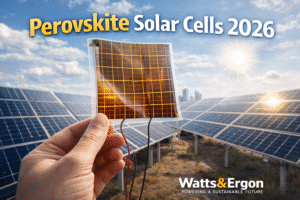
At Watts & Ergon, a DEWA-enrolled, ISO-certified solar EPC contractor, we design and install systems specifically engineered for UAE conditions. Here’s what actually works in 2026.