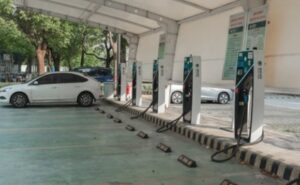
EV Charger Installation in Dubai: (2026 Guide)
At Watts & Ergon, a DEWA-approved solar and electrical contractor, we provide complete EV charger installation services for villas, apartments, offices, hotels, and commercial properties across Dubai.

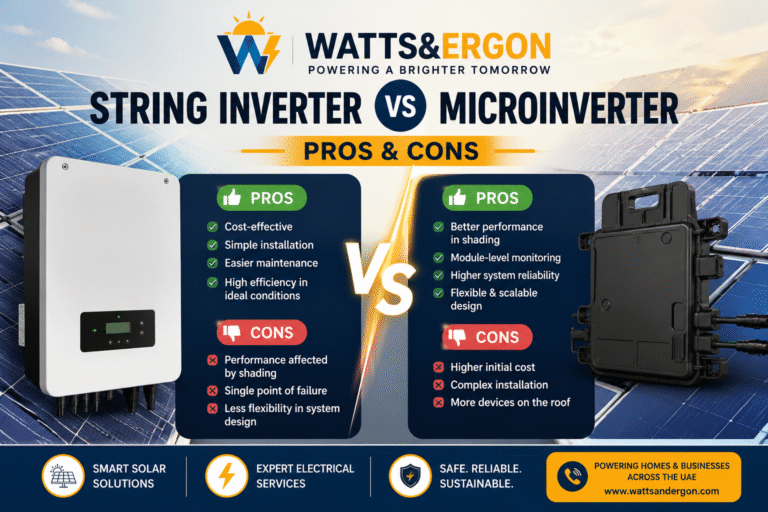
In the rapidly growing solar energy sector in the UAE, choosing the right inverter technology is one of the most critical decisions for maximizing return on investment. String inverters and microinverters represent two fundamentally different approaches to converting DC power from solar panels into usable AC electricity.
At Watts & Ergon, , a DEWA-approved solar contractor in Dubai, we help residential and commercial clients select the optimal inverter solution based on roof design, shading patterns, budget, and long-term energy goals. This comprehensive 2026 guide compares string inverters vs microinverters across all key factors.
String inverters are the traditional and most widely used technology. Multiple solar panels are connected in a “string” (series), and the combined DC power is fed to a single central inverter, usually mounted on a wall.
They have been the industry standard for decades due to their simplicity and lower cost.
Microinverters are small inverters installed on the back of each individual solar panel. Each panel operates independently, converting DC to AC right at the source before feeding power into your electrical system.
Key Difference: String inverters process power from multiple panels together, while microinverters give each panel its own dedicated inverter.
| Feature | String Inverter | Microinverter | Winner |
|---|---|---|---|
| Upfront Cost (5-10kW system) | Lower ($750–$2,500) | Higher ($1,500–$5,000+) | String |
| Lifespan | 10-15 years | 20-25 years | Microinverter |
| Warranty | 5-12 years | 20-25 years | Microinverter |
| Shading Performance | Poor (one panel drags down string) | Excellent (independent operation) | Microinverter |
| Energy Yield Gain | Baseline | 5-25% more in non-ideal conditions | Microinverter |
| Monitoring | String-level | Panel-level | Microinverter |
| Reliability / Failure Rate | Higher (single point failure) | Very Low (~0.05%) | Microinverter |
| Installation Complexity | Simpler | More components | String |
| System Expansion | Limited | Easy | Microinverter |
| Best For | Unshaded, simple roofs | Complex, shaded roofs | Depends |
In Dubai and the UAE’s harsh climate with occasional dust and high temperatures, microinverters often deliver better long-term performance due to individual panel optimization. Studies and field data show microinverter systems can produce 5-12% more energy annually in variable conditions common in urban residential settings.
For large commercial ground-mounted or perfectly south-facing unshaded arrays, string inverters remain highly competitive and more economical.
| Factor | String Inverter | Microinverter |
|---|---|---|
| Initial Cost | $12,000 – $16,000 | $16,000 – $22,000 |
| Inverter Replacement | 1-2 replacements (~$3,000–$6,000) | None |
| Energy Production (25 yrs) | Baseline | +8-15% higher |
| Estimated Savings | Good | Higher long-term ROI in shaded setups |
Systems like SolarEdge combine a central string inverter with DC power optimizers on each panel. They offer many benefits of microinverters at a lower cost premium than full microinverter setups.
As a trusted DEWA-approved solar EPC contractor in Dubai, Watts & Ergon provides unbiased recommendations between string inverters, microinverters, and hybrid optimizer systems. Our services include:
At Watts & Ergon, a DEWA-approved solar and electrical contractor, we provide complete EV charger installation services for villas, apartments, offices, hotels, and commercial properties across Dubai.
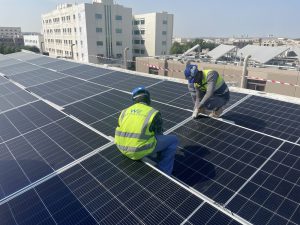
At Watts & Ergon, a DEWA-approved and ISO-certified solar EPC contractor, we specialize in designing and installing high-performance rooftop solar systems tailored specifically for warehouses, distribution centers, and industrial facilities across Dubai and the UAE.
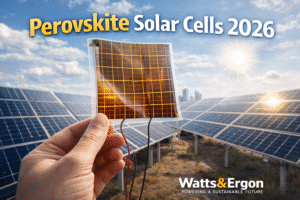
At Watts & Ergon, a DEWA-enrolled, ISO-certified solar EPC contractor, we design and install systems specifically engineered for UAE conditions. Here’s what actually works in 2026.