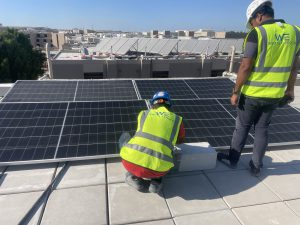
Dubai and other parts of the UAE enjoy one of the highest solar irradiance levels in the world. However, extreme summer temperatures — often exceeding 45°C to 50°C — significantly impact solar panel performance. While more sunlight should mean more power, high temperatures actually cause solar panels to lose efficiency.
Understanding how heat affects solar panels is crucial for anyone planning a solar installation in Dubai. At Watts & Ergon, , we specialize in designing heat-resistant solar systems optimized for the harsh desert climate of the UAE.
Most solar panels are rated at Standard Test Conditions (STC) of 25°C. For every degree above this temperature, panel efficiency drops. This loss is measured by the **Temperature Coefficient of Power** (usually between -0.3% to -0.5% per °C).
Key Fact: In Dubai’s peak summer, solar panels can easily reach surface temperatures of 65°C to 80°C, causing efficiency losses of 15% to 25% or more compared to rated capacity.
Solar Panel Temperature Coefficient Comparison (2026)
| Solar Panel Type |
Temperature Coefficient (%/°C) |
Efficiency Loss at 70°C |
Best Suited For |
Performance in Dubai Heat |
| Standard Mono PERC |
-0.40% to -0.45% |
18% – 20.25% |
Moderate Climates |
Average |
| Monocrystalline Half-Cut |
-0.35% to -0.40% |
15.75% – 18% |
General Use |
Good |
| Bifacial Solar Panels |
-0.30% to -0.35% |
13.5% – 15.75% |
High Irradiance Areas |
Very Good |
| PERC + TOPCon |
-0.29% to -0.35% |
13% – 15.75% |
Hot Climates |
Excellent |
| HJT (Heterojunction) |
-0.25% to -0.28% |
11.25% – 12.6% |
Extreme Heat |
Best in Class |
| Thin-Film (CdTe / CIGS) |
-0.20% to -0.25% |
9% – 11.25% |
Very High Temperatures |
Superior Heat Tolerance |
In Dubai’s summer months, ambient temperatures often hit 48°C while panel surface temperatures can reach 75–80°C. This leads to significant derating:
- A 550W panel may only produce 420–460W during peak afternoon hours.
- Annual energy yield can drop by 10–20% if the system is not designed for high temperatures.
- Without proper design, ROI on solar projects can be seriously affected.
Best Practices to Maximize Solar Efficiency in Extreme Heat
- Choose Low Temperature Coefficient Panels – Prefer HJT, TOPCon, or bifacial modules.
- Elevated Mounting Systems – Allow better airflow under the panels to reduce operating temperature by 5–10°C.
- Proper Ventilation & Spacing – Critical for rooftop and ground-mounted systems.
- Active Cooling Solutions – Water cooling or forced air systems for large installations.
- High-Quality Inverters with Temperature Compensation.
- Regular Cleaning & Maintenance – Dust combined with heat further reduces output.
- Professional System Design – Oversize the DC array slightly to compensate for heat losses.
At Watts & Ergon, we understand the unique challenges of installing solar in the UAE’s extreme climate. Our team designs and supplies heat-optimized solar solutions using the latest high-temperature resistant panels and advanced system engineering.
We help clients achieve maximum energy yield even during the hottest months, ensuring faster payback periods and long-term reliability.
Let our experts design a high-efficiency solar system that performs exceptionally well even in extreme heat.
Contact Watts & Ergon, today for a professional site assessment, accurate performance modeling, and the best solar + storage solutions tailored for Dubai’s climate.