
Utility Scale PV Projects Services
Watts & Ergon leads in utility-scale solar PV systems, delivering large-scale solar farms. Our Approved EPC services ensure sustainable power. Get a free solar project quote today!
Utility-scale photovoltaic (PV) projects require a specialized suite of Engineering, Procurement, and Construction (EPC) services to manage the transition from raw land to a high-capacity power plant connected to the national grid. These services begin with rigorous site assessment and engineering design, utilizing advanced modeling to optimize solar yield through precise row spacing and the integration of single or dual-axis tracking systems. Beyond the physical layout, EPC providers manage the procurement of Tier-1 components—including thousands of high-efficiency modules and industrial-grade central inverters—while coordinating complex logistics. The most critical phase involves substation integration and high-voltage (HV) engineering, where the plant’s DC output is stepped up via transformers to meet utility grid standards. This is coupled with the installation of robust SCADA systems for real-time monitoring and Earthing and Lightning Protection to safeguard the infrastructure. Finally, the service concludes with formal commissioning and grid-interconnection testing, ensuring the facility complies with strict local regulatory codes, such as those set by DEWA, to deliver reliable, large-scale renewable energy.
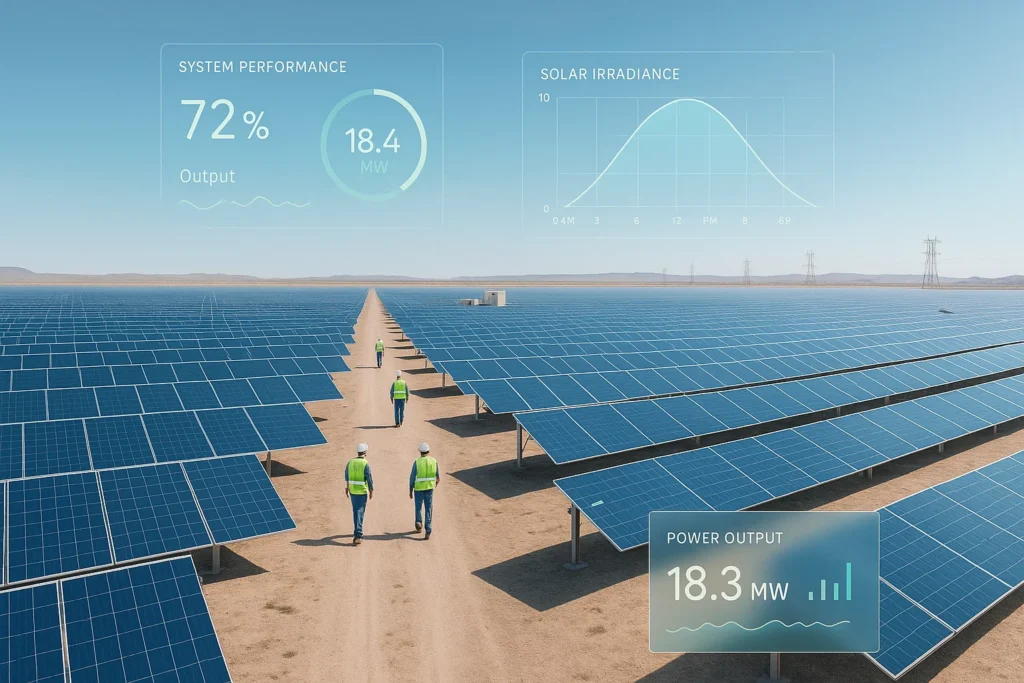
Solar Farm Development
Our Solar Farm Development services offer a strategic, turnkey approach to transforming vast desert landscapes into high-yielding energy assets through meticulous site selection and world-class engineering. We navigate the complexities of large-scale land development by conducting exhaustive topographical surveys, geotechnical soil analysis, and environmental impact assessments specifically tailored to the UAE’s unique climatic challenges. By leveraging high-efficiency bifacial solar modules paired with single-axis tracking systems, we optimize energy capture throughout the day while mitigating the performance-sapping effects of high ambient temperatures. Our development framework integrates robust grid-connection strategies and high-voltage substation design, ensuring seamless synchronization with the national power grid while maintaining full compliance with DEWA and ADDC regulatory frameworks. From securing land rights and managing complex procurement to the final commissioning of utility-scale infrastructure, we provide a bankable development model that prioritizes long-term durability, maximum ROI, and a sustainable future for the region’s energy portfolio.
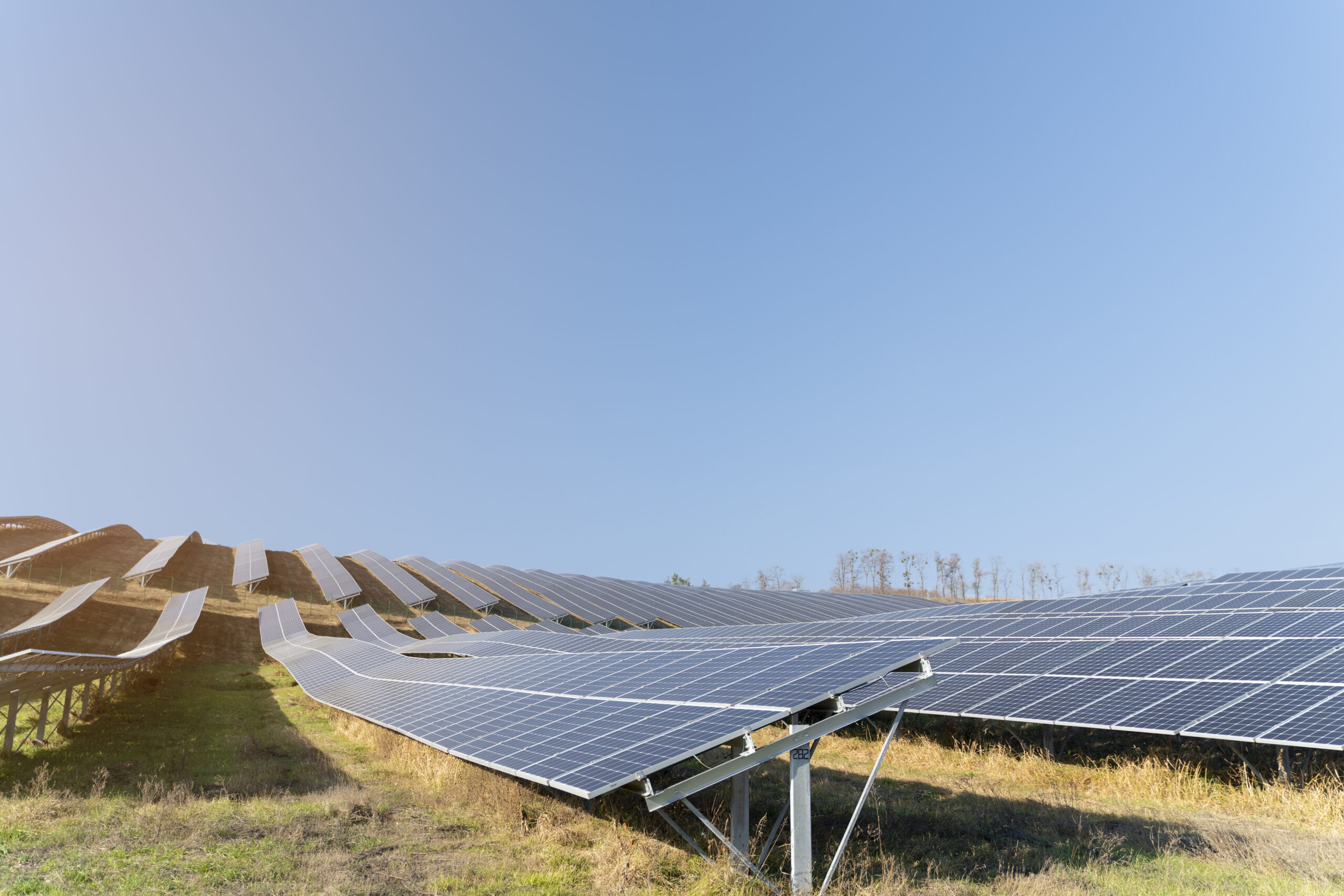
Grid-Tied System Integration
Watts & Ergon’s grid-tied solar installations include SCADA systems and substation integration.
Our Grid-Tied System Integration services offer a high-performance bridge between onsite solar generation and the national utility network, ensuring a seamless, bi-directional flow of energy for commercial and industrial facilities. We specialize in the precision engineering of synchronization systems that prioritize solar consumption while automatically balancing the load with the grid to maintain 24/7 power stability. Utilizing advanced Net Metering protocols in full alignment with DEWA (Shams Dubai) and ADDC/AADC regulations, our integration framework allows clients to export surplus energy back to the grid, effectively turning their roof space into a financial asset. Each system is equipped with industrial-grade Anti-Islanding protection, high-efficiency string or central inverters, and real-time SCADA monitoring to ensure the highest safety standards and power quality.
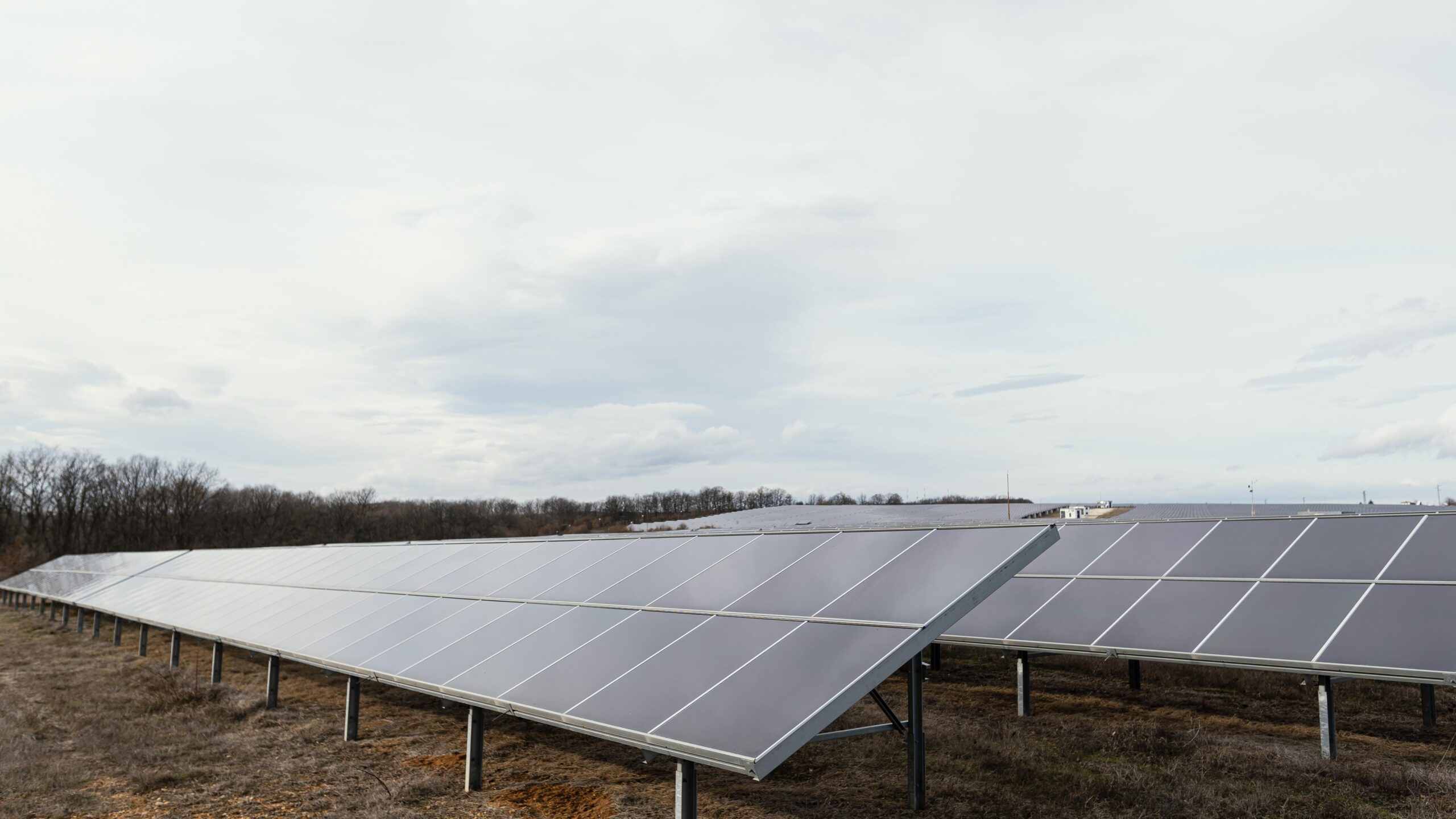
Grow with Utility Scale Solar: Sustainable Dubai Energy
In alignment with the Dubai Clean Energy Strategy 2050, utility-scale solar has emerged as the most bankable pathway for large-scale energy transition. For developers and industrial conglomerates, these assets represent long-term infrastructure designed for stable, low-cost electricity.
1. The Strategic Advantage in the UAE
Utilizing bifacial modules and single-axis trackers to increase energy yield by up to 25% compared to fixed systems.
Industrial-grade inverters with enhanced cooling to maintain peak efficiency even in 50°C ambient temperatures.
Nightly robotic dry-cleaning solutions that maximize output without consuming water resources.
2. End-to-End Development Framework
A. Feasibility & Pre-Development
We manage topographical surveys, geotechnical soil analysis, and Grid Impact Studies to ensure seamless synchronization with the local DEWA/ADDC grid stability.
B. EPC (Engineering, Procurement, & Construction)
Designing high-voltage (HV) substations and transmission lines (11kV to 132kV) while leveraging tier-1 partnerships for corrosion-resistant mounting systems.
C. O&M (Operations & Maintenance)
Real-time SCADA monitoring combined with Thermal Imagery analytics to identify and resolve faults before they impact performance.
3. Financial & Environmental Impact
| Impact Metric | Outcome for Investors & Dubai |
|---|---|
| LCOE Efficiency | Solar offers the lowest cost per kWh in the UAE, outperforming traditional gas-fired plants. |
| ESG & Carbon Credits | Generate I-RECs (International Renewable Energy Certificates) to meet global sustainability targets. |
| Grid Resilience | Reduces strain on centralized power hubs during peak summer cooling hours. |
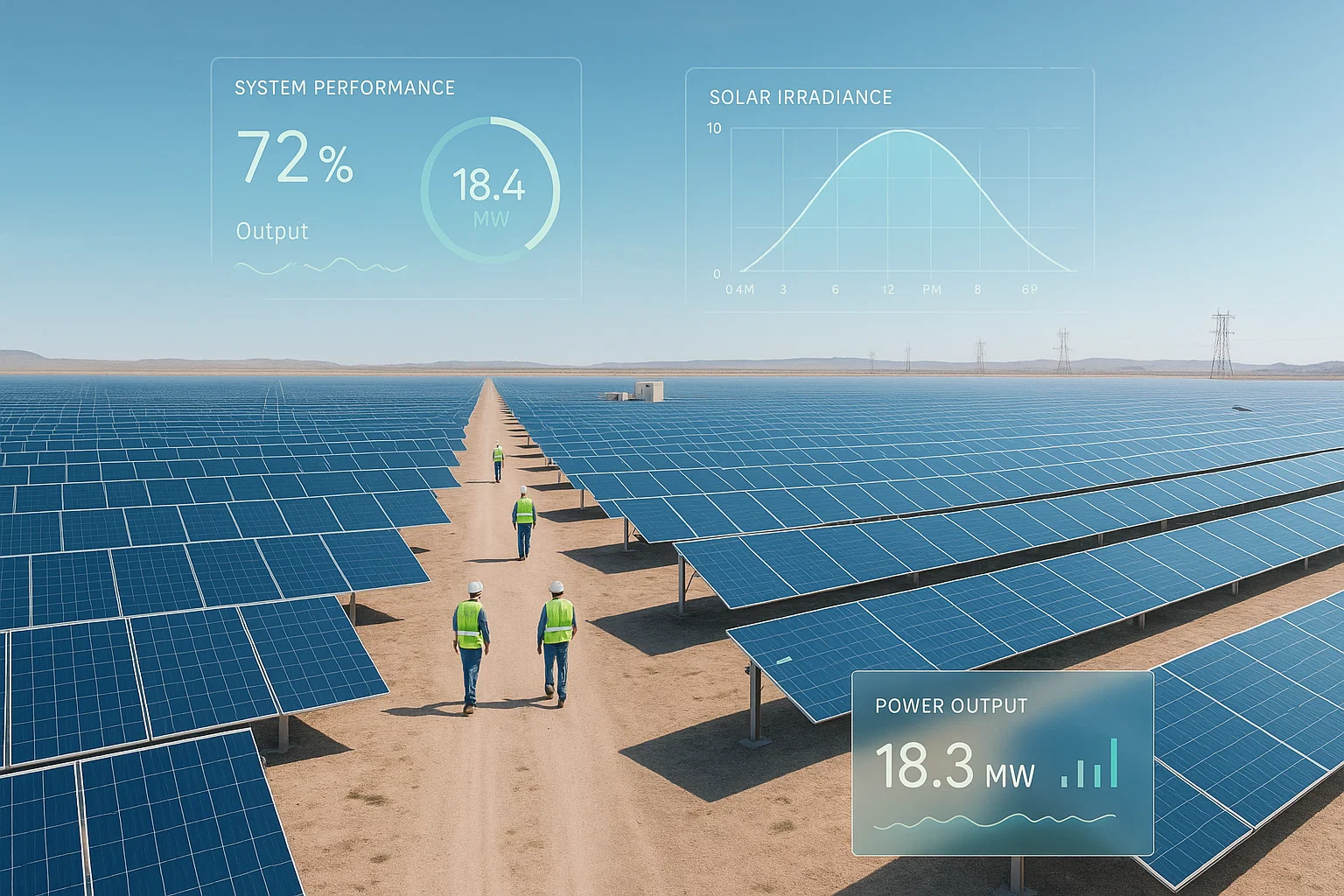
FAQs
A Utility-Scale Solar PV System is a massive power generation facility designed to generate electricity and feed it directly into the national high-voltage transmission grid. Unlike rooftop solar, which serves a single building, utility-scale projects act as wholesale power plants for the entire region.
1. Core Characteristics
Massive Capacity
Typically ranging from 10 MW to several Gigawatts (GW). In Dubai, these projects are central to reaching the net-zero goal by 2050.
Front-of-the-Meter
Energy is sold directly to utility providers like DEWA or ADDC via high-voltage substations, bypassing individual consumption meters.
Economies of Scale
By building at scale, the Levelized Cost of Energy (LCOE) is significantly lower than almost any other form of power generation.
2. Technical Comparison
| Feature | Utility-Scale Solar | Commercial Rooftop |
|---|---|---|
| Primary Connection | High-Voltage Transmission Grid | Building Distribution Board |
| Mounting System | Single-Axis Trackers (Ground) | Fixed-Tilt (Roof/Carport) |
| Panel Type | High-Efficiency Bifacial Modules | Standard Monofacial/Bifacial |
| Contract Type | Power Purchase Agreement (PPA) | Net Metering (Shams Dubai) |
A grid-tied solar installation (also known as an on-grid or grid-connected system) is a solar power setup that is directly connected to the local utility electricity grid.
How It Works
- Generation: Solar panels convert sunlight into DC electricity.
- Conversion: A grid-tied inverter converts that DC power into AC electricity for your home or business.
- Consumption & Export: Your building uses the solar power first. If your panels produce more than you need, the excess is sent back into the utility grid.
- Import: At night or on cloudy days, you automatically pull power from the grid just like a standard home.
- Net Metering: A bi-directional meter tracks both the power you take from the grid and the excess you send back. Your utility company then grants you credits for the power you provided, which offsets your bill.
Why Grid-Tied Systems are Preferred
For most residential and commercial users in urban or suburban areas, grid-tied systems are the standard choice for several reasons:
- Lower Upfront Cost: Because you don’t need a massive battery bank to store days’ worth of energy, the initial investment is significantly lower than off-grid or even most hybrid systems.
- Higher Efficiency: There is no “wasted” energy. Any surplus your system generates is utilized by the grid, and you get financial credit for it.
- Seamless Reliability: You don’t have to worry about running out of stored battery power during a week of rainy weather. The grid is always there as a constant backup.
- Minimal Maintenance: Batteries are often the most high-maintenance part of a solar setup. Eliminating them means fewer components that can fail or require replacement over time.
- Faster ROI: Between the lower setup costs and the savings from net metering, grid-tied systems typically pay for themselves much faster (often within 6–9 years).
We provide a comprehensive range of engineering and supply services designed for industrial, utility-scale, and high-end residential applications. Our focus is on delivering high-efficiency, compliant, and sustainable energy solutions.
Core Engineering & Technical Services
- Grid-Tied System Integration: Designing and commissioning systems that seamlessly synchronize with the local utility grid, maximizing efficiency and enabling net-metering benefits.
- Panel Installation & Commissioning: Full-scale services for LV, MV, and HV (Low, Medium, and High Voltage) electrical panels to ensure safe and stable power distribution.
- Utility-Scale & Solar Farm Development: Engineering support for large-scale photovoltaic projects, from site assessment to final implementation.
- Automated Energy Storage (BESS): Integrating advanced lithium battery technologies with automated management systems for peak shaving and backup power.
- Safety & Protection Systems: Designing and installing robust Earthing and Lightning Protection systems to safeguard infrastructure against electrical surges.
Equipment & Infrastructure Supply
Operating through professional channels to provide industry-grade components for electrical and solar projects:
| Category | Key Products |
|---|---|
| Solar Infrastructure | High-efficiency PV panels, industrial-grade inverters, and mounting hardware. |
| Energy Storage | Advanced Lithium-ion battery banks for residential and industrial backup. |
| Electrical Supplies | Specialized wiring, professional-grade tools, and distribution (DB) boxes. |
Specialized Maintenance & Compliance
We prioritize preventive maintenance and safety compliance, particularly for Distribution Board (DB) inspections, ensuring that all installations meet the rigorous safety standards required for the regional market.
In the world of utility-scale energy, EPC stands for Engineering, Procurement, and Construction. Solar EPC contractors are specialized firms that provide a “turnkey” solution, handling the entire lifecycle of a solar project from initial design to final commissioning.
The Three Pillars of the EPC Role
1. Engineering (The Design)
- Feasibility & Site Surveys: Analyzing solar irradiance and soil conditions.
- System Modeling: Predicting energy yield and optimizing layout.
- Electrical Design: Wiring diagrams and grid connection architecture.
2. Procurement (The Sourcing)
- Tier-1 Sourcing: Sourcing high-quality, bankable panels and inverters.
- Logistics: Coordinating global transport for thousands of components.
- BOS (Balance of System): Procuring mounting, cabling, and transformers.
3. Construction (The Execution)
- Civil Works: Site clearing and foundation installation.
- Mechanical & Electrical: Physical mounting and high-voltage integration.
- Commissioning: Rigorous testing for safety and performance guarantees.
Why EPCs are Essential for Large Projects
| Benefit | How it Works |
|---|---|
| Risk Transfer | The contractor assumes the risk of delays, technical failures, and cost overruns. |
| Performance Guarantees | Contracts often guarantee specific energy outputs, backed by liquidated damages. |
| Single Point of Contact | The owner manages one entity instead of dozens of individual vendors. |
| Regulatory Compliance | EPCs handle complex permitting and grid interconnection (e.g., DEWA/local utility). |
EPC vs. EPCM
While an EPC contractor builds the project themselves (Turnkey), an EPCM (Management) firm acts as a consultant managing the project for the owner. For most large solar farms, the EPC model is preferred because it offers the highest level of price and schedule certainty.
In a large-scale solar power plant, the substation acts as the “brain and heart” of the facility. While solar panels generate the energy, the substation is responsible for transforming that energy into a format compatible with the national grid and managing the complex flow of electricity.
Key Roles of Substation Integration
Uses large transformers to “step up” low/medium voltage from solar arrays to high-voltage levels (e.g., 132kV or 400kV) for long-distance transmission.
Ensures the plant’s output matches the grid’s frequency and phase. Manages reactive power compensation and harmonic filtering for stability.
Houses critical switchgear and protective relays. In the event of a fault, the system isolates the section in milliseconds to prevent damage.
Supervisory Control and Data Acquisition (SCADA) allows for real-time monitoring of energy production and remote control of high-voltage panels.
Impact on Project Success
| Feature | Importance in Integration |
|---|---|
| Efficiency | Minimizes transmission losses between the field and the grid. |
| Compliance | Ensures the plant meets strict Grid Code requirements (essential for regional utility approval). |
| Safety | Provides a centralized point for emergency shutdowns and earthing protection. |
| Longevity | Proper integration prevents equipment stress caused by voltage spikes or poor power quality. |
The Role of the EPC in Integration
For a Solar EPC contractor, substation integration is often the most technically demanding phase. It requires precise engineering of Earthing and Lightning Protection systems and the commissioning of specialized LV/MV/HV panels to ensure the plant can officially “go live.”
Solar panel trackers are mechanical devices that orient photovoltaic panels toward the sun throughout the day. By minimizing the angle of incidence, trackers ensure that cells receive maximum solar intensity, significantly boosting the energy yield of large-scale solar farms.
Primary Tracking Technologies
Single-Axis Trackers (SAT)
Typically rotates on a horizontal North-South axis, following the sun from East to West.
- Yield Gain: 15% – 25%
- Best For: Large, flat utility-scale projects in low latitudes.
Dual-Axis Trackers
Adjusts on both horizontal and vertical axes to track exact solar position seasonally.
- Yield Gain: 35% – 45%
- Best For: High-latitude regions or concentrated solar applications.
Key Performance Benefits
- Extended Peak Generation: Maintains high output from early morning through late afternoon, rather than just at solar noon.
- Optimized LCOE: While initial CAPEX is higher, the increased energy production lower the Levelized Cost of Energy over the project’s life.
- Grid Stability: Higher production during late afternoon aligns well with peak demand periods for utility providers.
The Engineering Challenge
For Solar EPC contractors, trackers introduce mechanical complexity that requires specialized expertise:
- Wind Loading: Systems must feature “stow” modes to flatten panels during high-wind events to prevent structural failure.
- Terrain Management: Requires precise site grading as long tracking rows are sensitive to uneven terrain.
- O&M Requirements: Moving parts (motors, sensors, and gears) necessitate a robust preventive maintenance schedule.