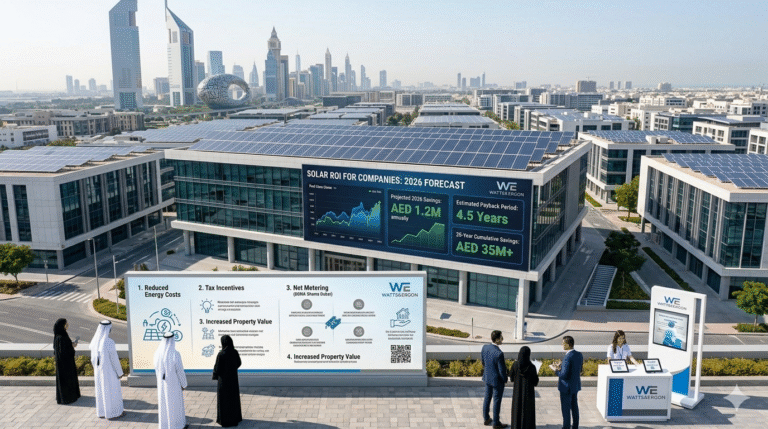
In 2026, the conversation around commercial real estate in the UAE has shifted from luxury and location to efficiency and sustainability. With the UAE’s Net Zero 2050 strategy in full swing and electricity tariffs evolving, commercial building owners are looking at their rooftops not just as shelter, but as untapped revenue streams.
At Watts & Ergon, we’ve seen firsthand how high-performance solar PV systems transform operational expenses into long-term assets. But the big question remains: What is the actual Return on Investment (ROI) for solar on a commercial building?
This guide breaks down the technical, financial, and regulatory factors that determine your solar ROI in 2026.
ROI in solar isn’t just about “saving on the bill.” For a business, it is a complex calculation involving several variables:
- Direct Savings: Immediate reductions in monthly utility payments.
- Tax & Incentive Benefits: Leveraging local government schemes and green building credits.
- Asset Value: The tangible increase in the building’s market valuation.
- Operational Resilience: Protecting the business against future tariff hikes and inflation.
The Financial Logic
In the UAE’s high-irradiance environment, commercial systems in 2026 are typically seeing an annual ROI of 15% to 22%, significantly outperforming traditional financial market investments or low-interest savings accounts.
2. Key Drivers of Solar ROI in 2026
Several factors have aligned in 2026 to make this the “Golden Year” for commercial solar in Dubai, Abu Dhabi, and the Northern Emirates.
A. Economies of Scale
Commercial systems (typically 50kW to 1MW+) benefit from lower “per-watt” pricing compared to residential villas. While a 10kW residential system might cost AED 2.30 per watt, a 200kW commercial rooftop system often drops to AED 1.70 – AED 2.00 per watt due to bulk purchasing of panels and industrial inverters.
B. High Daytime Consumption
Unlike residential users who consume most power in the evening, commercial buildings—offices, warehouses, and malls—peak during the day. This “load-matching” maximizes self-consumption and yields the fastest ROI.
C. Regulatory Support: Shams Dubai and Beyond
The DEWA Shams Dubai initiative remains a cornerstone for ROI. By allowing businesses to export excess energy back to the grid and receive 1:1 credits on their bills, the “grid” essentially acts as a free battery storage solution.
The “Payback Period” is the time it takes for the cumulative energy savings to equal the initial investment. In 2026, these periods have reached record lows.
| System Size |
Estimated Cost (AED) |
Annual Savings (AED) |
Payback Period (Years) |
25-Year Net Profit |
| 50 kW (Small Office) |
90,000 – 110,000 |
22,000 |
4.5 – 5.0 |
~ AED 450,000 |
| 250 kW (Warehouse) |
425,000 – 480,000 |
115,000 |
3.8 – 4.2 |
~ AED 2,400,000 |
| 500 kW (Industrial) |
800,000 – 950,000 |
240,000 |
3.5 – 4.0 |
~ AED 5,000,000 |
*Note: Estimates based on current commercial tariffs and 1,800+ kWh/kWp annual yield.*
4. Advanced Technology and Its Impact on ROI
At Watts & Ergon, we don’t just provide panels; we provide engineered solutions. The technology you choose in 2026 directly impacts your 25-year financial performance.
High-Efficiency N-Type TOPCon Panels
In 2026, N-Type panels have become the industry standard. They offer:
- Lower Degradation: Ensuring your system still produces at 87% capacity after 30 years.
- Better Heat Tolerance: Crucial for the UAE summer, where standard panels lose efficiency as temperatures exceed 40°C.
Industrial Inverters and Smart Monitoring
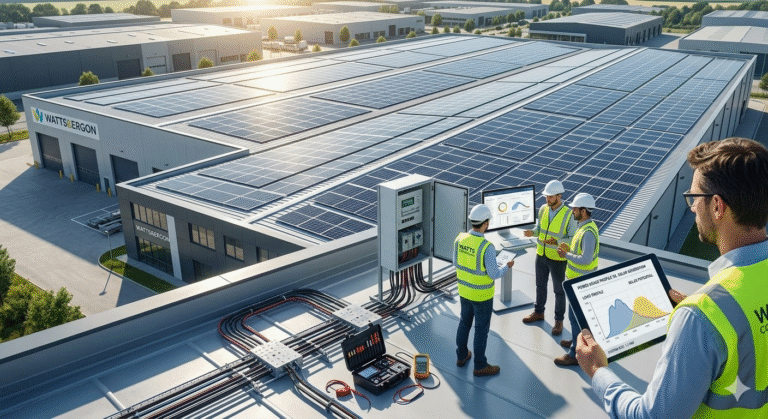
Modern industrial inverters now come with built-in AI diagnostics. By identifying a “soiled” panel or a minor wiring fault instantly, these systems prevent the 5-10% “silent loss” of revenue that often goes unnoticed.
5. Maintenance: Protecting Your Investment
Solar is “low maintenance,” but in the Middle East, it is not “no maintenance.” Dust and “soiling” can reduce ROI by up to 30% if left unmanaged. At Watts & Ergon, we specialize in electrical components and tools designed for high-durability maintenance.
- Automated Cleaning: Cost-effective robotic cleaning for large rooftops.
- Thermal Imaging: Using drones to detect hot spots in cells before they fail.
- Electrical Testing: Ensuring all DC/AC connections remain tight in extreme heat.
6. Environmental and ESG Benefits
In 2026, ROI isn’t just measured in Dirhams. Many commercial entities in the UAE are now subject to ESG (Environmental, Social, and Governance) reporting.
- Carbon Credits: Your solar production can be converted into I-RECs (International Renewable Energy Certificates).
- Property Premium: Buildings with “Green” certifications command 5-10% higher rental yields and resale values in the Dubai and Abu Dhabi markets.
Navigating the technical and legal landscape of commercial solar requires an expert partner. Our 5-step process ensures your ROI is locked in:
- Energy Audit: Analyzing your utility history.
- Feasibility Study: LiDAR and 3D modeling for rooftop shading.
- Regulatory Approval: Handling all government paperwork.
- Premium Installation: Using Tier-1 components and industrial-grade wiring.
- 24/7 Monitoring: Real-time performance tracking.
Watts & Ergon,