The solar energy industry is evolving rapidly. While silicon solar panels have dominated for decades, a new technology—perovskite solar cells—is gaining attention due to its high efficiency and low cost potential.
What Are Perovskite Solar Cells?
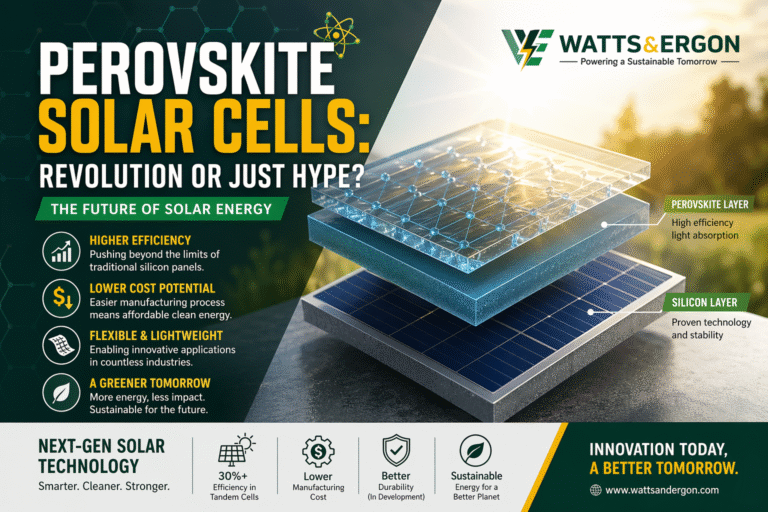
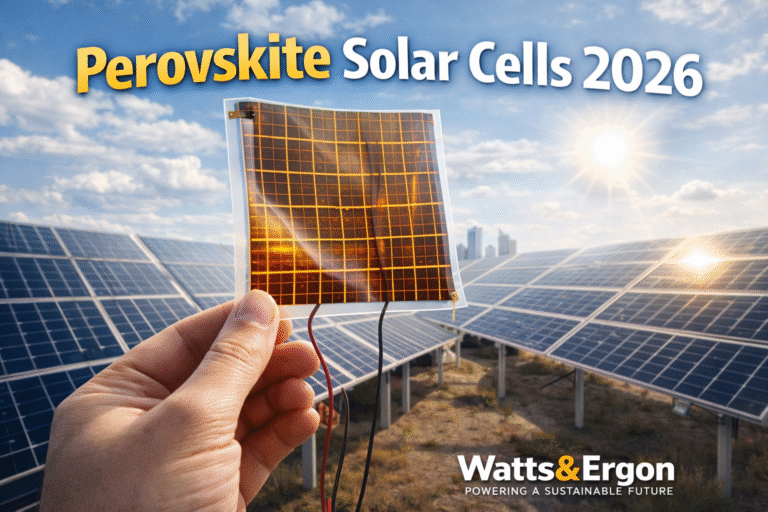
Perovskite solar cells use a unique crystal structure material that absorbs sunlight and converts it into electricity. These cells are lightweight, flexible, and easier to manufacture compared to traditional silicon panels.
Efficiency Comparison
| Technology Type |
Average Efficiency (2026) |
Maximum Efficiency (Lab) |
| Silicon Solar Panels |
20% – 26% |
~27% |
| Perovskite (Single Junction) |
25% – 26% |
~26.7% |
| Perovskite-Silicon Tandem |
29% – 33% |
~34%+ |
1. High Efficiency
Perovskite solar cells have achieved over 30% efficiency in tandem configurations, surpassing traditional silicon limits.
2. Lower Cost
They can be manufactured using low-temperature processes, reducing production costs significantly.
3. Flexible Applications
- Solar windows
- Wearable devices
- Curved surfaces
4. Better Light Absorption
They absorb a wider spectrum of sunlight, improving overall energy generation.
Challenges and Limitations
1. Stability Issues
Perovskite materials degrade under heat, moisture, and UV exposure.
2. Toxicity Concerns
Many cells contain lead, raising environmental concerns.
3. Limited Commercialization
Large-scale production is still under development.
Advantages vs Disadvantages
| Advantages |
Disadvantages |
| High efficiency |
Stability issues |
| Low cost |
Short lifespan |
| Flexible design |
Lead toxicity |
| Lightweight |
Scaling challenges |
| Feature |
Silicon Panels |
Perovskite Cells |
| Efficiency |
Moderate |
High |
| Cost |
Medium |
Low (future) |
| Lifespan |
25–30 years |
Under testing |
| Flexibility |
Rigid |
Flexible |
Applications
- Building-integrated solar (windows & facades)
- Electric vehicles
- Portable electronics
- Space technology
Market Trends
The solar industry is investing heavily in perovskite technology, with expected commercialization between 2026 and 2032.
ROI Comparison
| System Type |
Cost |
Efficiency |
ROI |
| Silicon |
Medium |
Medium |
Stable |
| Perovskite |
Low (future) |
High |
High |
| Tandem |
High |
Very High |
Best |
Final Verdict
Perovskite solar cells are a long-term revolution but still evolving.
Conclusion
Perovskite solar cells have the potential to transform the solar industry with higher efficiency and lower costs. However, challenges like durability and scalability must be addressed before widespread adoption.
Watts & Ergon, provides expert solutions and insights in solar and electrical systems, helping clients stay ahead in modern energy technologies.