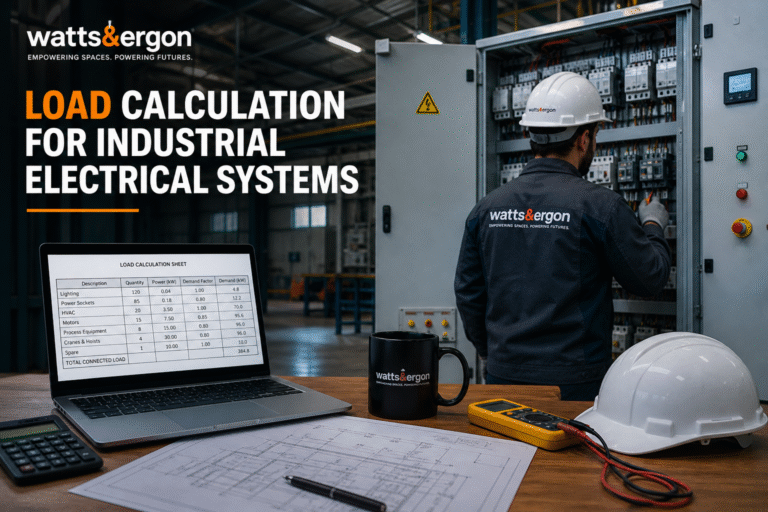
Industrial electrical systems power heavy machinery, motors, lighting, HVAC, and process equipment in factories, manufacturing plants, and warehouses. Accurate load calculation is essential to properly size transformers, switchgear, cables, breakers, and the main service entrance.
Undersized systems risk overheating, frequent trips, costly downtime, and fire hazards. Oversized systems waste capital on unnecessary equipment. Proper calculations ensure safety, reliability, energy efficiency, and compliance with standards like NEC or IEC guidelines.
At Watts & Ergon, , we specialize in designing robust industrial electrical systems across the UAE and beyond, helping clients in Dubai and other industrial hubs avoid costly mistakes through precise load studies.
- Safety & Compliance – Prevents overloads and ensures adherence to local and international codes.
- Cost Optimization – Balances initial investment with long-term operational efficiency.
- Future-Proofing – Accounts for plant expansion and peak demands.
- Power Quality – Manages harmonics from VFDs and non-linear loads.
- Energy Management – Helps reduce peak consumption through smart demand factors.
Types of Loads in Industrial Electrical Systems
- Motor Loads – The largest portion in most plants (pumps, compressors, conveyors, etc.).
- Lighting Loads
- HVAC & Heating Loads
- Process & Machinery Loads (welding, furnaces, CNC machines)
- Receptacle & Miscellaneous Loads
- Non-Linear Loads (VFDs, UPS systems)
Note: Continuous loads (operating more than 3 hours) usually require a 125% multiplier for conductor and overcurrent device sizing.
Key Concepts: Demand Factor, Diversity Factor & Load Factor
| Type of Industry |
Demand Factor |
Load Factor |
Utilization Factor |
| Arc Furnace |
0.55 |
0.80 |
0.44 |
| Induction Furnace |
0.90 |
0.80 |
0.72 |
| Steel Rolling Mills |
0.80 |
0.25 |
0.20 |
| Mechanical/Electrical (Single Shift) |
0.45 |
0.25 |
0.11 |
| Mechanical/Electrical (Double Shift) |
0.45 |
0.50 |
0.22 |
Step-by-Step Guide to Industrial Load Calculation
- Collect all equipment nameplate data (kW, HP, voltage, PF, efficiency).
- Categorize loads (motors, lighting, HVAC, continuous, non-continuous).
- Calculate total connected load in kW or kVA.
- Apply appropriate demand and diversity factors.
- Add 25% of the largest motor load (common practice for feeders).
- Include spare capacity for future expansion (20–30%).
- Calculate full load current using the 3-phase formula.
Three-Phase Current Formula:
Current (A) = (kW × 1000) / (√3 × Voltage × Power Factor)
| Load Type |
Quantity |
Rating per Unit |
Connected Load (kW) |
Demand Factor |
Demand Load (kW) |
| Induction Motors |
15 |
5–20 HP |
180 |
0.75 |
135 |
| Lighting |
– |
1.5 VA/ft² |
45 |
0.90 |
40.5 |
| HVAC/Chillers |
2 |
50 kW |
100 |
0.80 |
80 |
| Welding Machines |
8 |
15 kVA |
120 |
0.60 |
72 |
| Compressors & Pumps |
6 |
10 kW |
60 |
0.70 |
42 |
| Receptacles & Misc. |
– |
– |
25 |
0.50 |
12.5 |
| Total |
530 kW |
– |
382 kW |
Best Practices and Common Pitfalls
- Always use actual nameplate data instead of assumptions.
- Consider harmonics from VFDs and plan for derating or filters.
- Perform load flow, short-circuit, and arc-flash studies for large systems.
- Document all calculations for authority approvals.
- Engage qualified electrical engineers early in the project.
Need Professional Load Calculation & Electrical Design?
Watts & Ergon delivers precise, code-compliant industrial electrical solutions tailored for your facility in Dubai and across the UAE.
Contact us today for expert load studies, panel design, and complete power system engineering.