As solar energy adoption accelerates across the globe, the focus is shifting from simple energy generation to long-term system reliability and safety. Among the various technical challenges faced by asset owners and installers, Arc Faults remain one of the most significant risks to both property and personnel.
At Watts & Ergon, , we believe that a safe solar installation starts with deep technical understanding. This guide provides an exhaustive look into the physics of arcing, the leading causes of failure, and the cutting-edge technologies used to mitigate these risks.
1. What is a Solar Arc Fault?
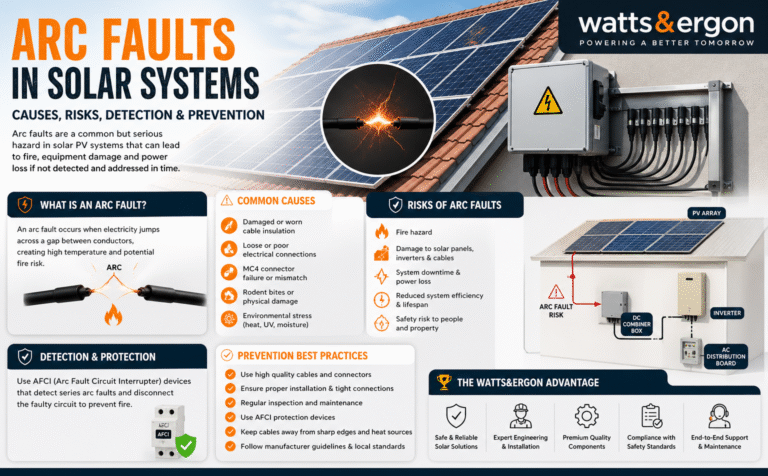
An arc fault is an unintended electrical discharge that flows through the air between two conductors. In a DC (Direct Current) solar system, this occurs when the voltage is high enough to ionize the air, creating a plasma path that conducts electricity.
Unlike AC (Alternating Current) arcs, which naturally extinguish as the current crosses “zero” 50 to 60 times per second, DC arcs are sustained. Once a DC arc starts, it will continue to burn as long as there is sunlight hitting the panels and a sufficient voltage gap. These arcs can reach temperatures exceeding 3,000°C, which is more than enough to melt copper, glass, and aluminum, and ignite roofing materials.
The Three Types of Arc Faults
- Series Arc Fault: Occurs when a single conductor is broken or a connection becomes loose. The current “jumps” across the small gap in the path of the circuit. Common in loose MC4 connectors or cracked solder joints within a panel.
- Parallel Arc Fault: Occurs when an insulation failure allows current to jump between two different conductors (e.g., between the Positive and Negative DC strings).
- Ground Fault Arc: Occurs when current jumps from a damaged conductor to the grounded metal racking or the building’s structure.
2. Root Causes: Why Do Arcs Happen?
Most arc faults are not sudden accidents but the result of cumulative stress or installation errors.
A. Installation Defects
Research suggests that over 36% of solar fires are linked to installation issues:
- Improper Crimping: Using the wrong tool creates high resistance.
- Mismatched Connectors: Mixing different brands of “MC4-compatible” connectors leads to moisture ingress.
- Incorrect Torque: Under-tightening leads to loose contacts; over-tightening can crush the wire.
B. Environmental & Biological Stress
- Thermal Cycling: Constant expansion and contraction can physically back out screws.
- UV Degradation: Low-quality cable insulation can become brittle and crack.
- Pest Activity: Rodents chewing through wires creates prime locations for parallel arc faults.
| Component |
Common Failure Mode |
Prevention |
| DC Connectors |
Moisture ingress/Corrosion |
Use matched pairs from one manufacturer. |
| Junction Boxes |
Solder joint fatigue |
Choose Tier 1 modules with potted J-boxes. |
| DC Cabling |
UV damage or rodent bites |
Use galvanized steel or UV-rated conduits. |
| Inverter Terminals |
Loose connections |
Annual torque verification with calibrated tools. |
3. Detection Technology: The Role of AFCI
To combat these risks, modern inverters provided by Watts & Ergon often come equipped with integrated Arc Fault Circuit Interrupters (AFCI).
The AFCI unit constantly monitors the DC current for specific high-frequency electrical “noise” (usually between 10kHz and 100kHz). Once a sustained arc signature is detected, the AFCI trips, opening the circuit and extinguishing the arc in milliseconds.
Note: International standards like UL 1699B and IEC 63027 define the strict testing requirements for these devices to ensure they trip when necessary but avoid false shutdowns.
4. Advanced Mitigation: AI and Machine Learning
In 2026, the cutting edge of solar safety involves AI-driven diagnostics. Newer systems use Deep Learning to build a library of arc signatures, allowing the inverter to distinguish between a dangerous arc and harmless electrical noise from motors or grid fluctuations.
5. The Watts & Ergon Maintenance Protocol
We recommend a multi-layered approach to system health:
- Thermal Imaging: Identifying “hot spots” in connectors invisible to the naked eye.
- Insulation Resistance Testing: Using a Megohmmeter to identify insulation breakdown before it leads to a leak.
- Mechanical Audit: Re-verifying torque settings and inspecting conduit integrity.
6. Conclusion: Protecting Your Investment
An arc fault doesn’t just represent a fire risk; it represents a failure in the promise of renewable energy. By choosing high-quality components—from the inverters and batteries down to the very wires and tools used for installation—you ensure that your system remains a source of power, not a source of worry.
At Watts & Ergon, we specialize in providing the heavy-duty, compliant electrical components needed to build systems that stand the test of time.
Technical Summary for Engineers
| Parameter |
Standard / Value |
Importance |
| Arc Temperature |
Up to 3,000°C+ |
Can ignite almost any roofing material. |
| Detection Standard |
UL 1699B / IEC 63027 |
Ensures reliability of AFCI hardware. |
| Key Testing Tool |
Megohmmeter (1000V) |
Identifies insulation breakdown before arcing. |
| Critical Component |
MC4 Connectors |
Most common site of series arc failures. |