Solar panels don’t just slash your electricity bill — in many parts of the country, they can actually
pay you through net metering. But with policy changes sweeping across states in 2026, understanding the details has never been more important.
At Watts & Ergon, we’ve helped hundreds of homeowners navigate net metering to maximize their returns. In this comprehensive guide, we’ll break down everything you need to know.
What Is Net Metering?
Net metering is a billing arrangement between you and your utility company that allows solar panel owners to send excess electricity generated by their system back to the grid and receive credits on their bill.
Think of it as a giant virtual battery. During sunny days when your panels produce more power than your home needs, the surplus flows into the grid. Your utility credits you for that energy — often at full retail rates in strong net metering states.
“Net metering turns solar from a cost-saving tool into a genuine earning opportunity.”
— Watts & Ergon, Solar Experts
How Net Metering Actually Works (Step-by-Step)
- Solar Production: Your panels generate DC electricity converted to AC by your inverter.
- Self-Consumption: Power first serves your home’s real-time needs (lights, AC, appliances).
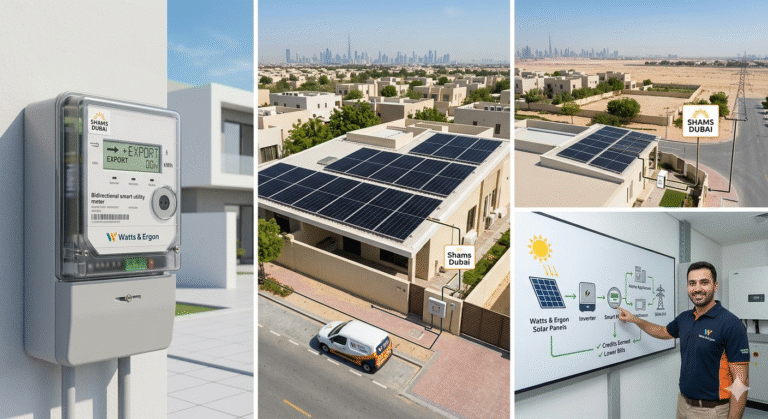
- Export to Grid: Excess electricity flows through your bi-directional meter to the utility grid.
- Crediting: You receive a credit (usually 1:1 in traditional programs) for every kWh exported.
- Import from Grid: At night or on cloudy days, you draw power and use up your credits.
- True-Up: Most utilities reconcile annually. Leftover credits may roll over or be paid out at a lower rate.
Traditional Net Metering vs. Net Billing in 2026
| Feature |
Traditional 1:1 Net Metering |
Net Billing (NEM 3.0 style) |
| Export Compensation |
Full retail rate (e.g. $0.25–$0.40/kWh) |
Wholesale / avoided cost (often $0.05–$0.12/kWh) |
| Best For |
High electricity rate states |
Paired with battery storage |
| Payback Impact |
Faster (6–9 years) |
Slower without batteries |
Real Earnings: How Much Can You Actually Make?
Here are realistic examples based on 2026 data:
| System Size |
Annual Production |
Excess Exported |
Rate |
Annual Credit |
| 6 kW |
8,400 kWh |
2,500 kWh |
$0.28/kWh |
$700 |
| 8 kW |
11,200 kWh |
3,800 kWh |
$0.32/kWh |
$1,216 |
| 10 kW |
14,000 kWh |
5,000 kWh |
$0.22/kWh |
$1,100 |
State-by-State Net Metering Policies in 2026
| State |
Policy Type |
Credit Rate |
Notes |
| California |
Net Billing (NBT) |
~ $0.05–$0.12 |
Strong incentive for batteries |
| Texas |
Varies by utility |
Retail in many areas |
Highly competitive market |
| New York |
Value of DER |
Varies |
Location-based credits |
| Florida |
Net Metering |
Full retail |
Excellent solar potential |
| Washington |
1:1 Net Metering |
Full retail |
Until 2029 or cap hit |
Why Net Metering Is Changing in 2026
Utilities argue that traditional net metering shifts grid maintenance costs to non-solar customers. As solar adoption grows rapidly, many states have moved toward net billing, time-of-use rates, and fixed charges.
The good news? Existing systems are almost always grandfathered for 15–20+ years.
Net Metering + Battery Storage: The Ultimate Combo
In states with reduced export credits, pairing solar with batteries can dramatically increase your earnings and independence. Store excess daytime production and use it during expensive peak evening hours.
Case Studies: Real Homeowners Earning with Solar
Sarah M., Austin, TX
$1,850/year
8.5 kW system • Strong net metering • Payback in 6.8 years
Michael R., Phoenix, AZ
$2,340/year
12 kW system with batteries • Time-of-use optimization
Common Myths About Net Metering
- Myth: You’ll get a check every month. Reality: Most people see credits applied to future bills.
- Myth: Net metering is disappearing everywhere. Reality: Many strong programs remain.
Watts & Ergon ‘s Pro Tips for Maximizing Net Metering Benefits
-
01
Get a professional site assessment to optimize panel orientation and avoid shading.
-
02
Understand your utility’s exact tariff before signing.
-
03
Consider battery storage in weak net metering areas.
Ready to Start Earning with Solar?
Our experts will analyze your specific utility rules and design a system optimized for maximum credits and savings.
Get Your Free Net Metering Analysis
This article is for informational purposes only. Policies change frequently. Contact Watts & Ergon, and your utility for the most current information specific to your location. Data compiled from industry reports and 2026 utility tariffs.