EV Charger Installation in Dubai: (2026 Guide)
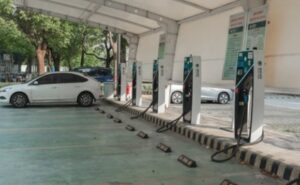
At Watts & Ergon, a DEWA-approved solar and electrical contractor, we provide complete EV charger installation services for villas, apartments, offices, hotels, and commercial properties across Dubai.

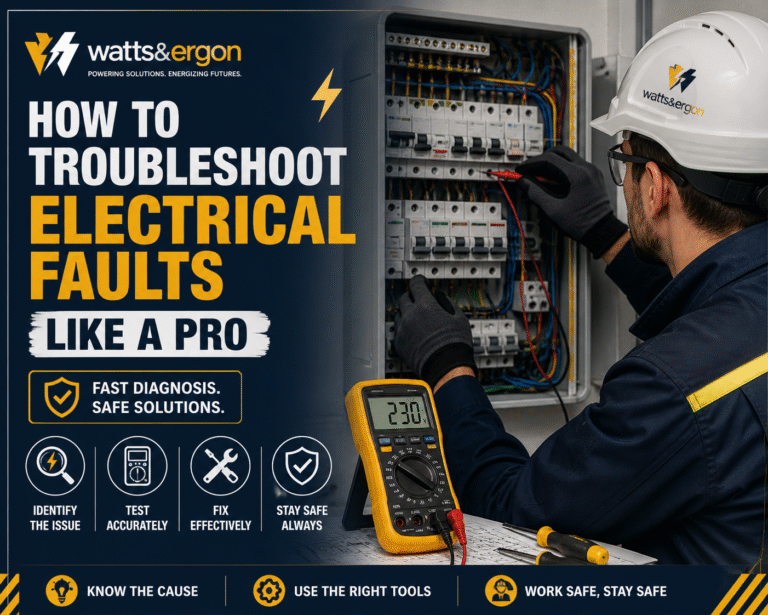
Electrical faults are among the most common yet dangerous issues in homes, villas, and commercial buildings across Dubai and the UAE. With extreme temperatures, dust storms, high humidity, and heavy air-conditioning loads, the electrical systems here face unique stresses.
Learning how to troubleshoot electrical faults systematically can save you time, money, and potentially your life. However, safety always comes first. This comprehensive guide walks you through professional methods while emphasizing when you must call licensed experts like Watts & Ergon .
Whether you’re a homeowner, facility manager, or aspiring electrician, mastering these steps will help you diagnose issues confidently and efficiently.
| Tool | Purpose | Recommended Specs |
|---|---|---|
| Digital Multimeter | Voltage, current, continuity, resistance | True RMS, CAT III 600V or higher |
| Non-Contact Voltage Tester | Quick live circuit detection | With flashlight & beep |
| Insulation Resistance Tester (Megger) | Check cable insulation | 500V / 1000V models |
| Clamp Meter | Measure current without breaking circuit | AC/DC with inrush function |
| Circuit Breaker Finder | Identify which breaker controls which circuit | With GFCI testing |
| Thermal Camera (Advanced) | Detect hot spots and overloads | FLIR or similar |
This methodical approach prevents guesswork and reduces the chance of missing hidden issues.
Start at the main distribution board (MDB). Check the main incoming supply, then individual MCBs or RCCBs.
| Possible Cause | Diagnostic Steps | Solution |
|---|---|---|
| Main breaker tripped | Visual check + voltage test | Reset after identifying cause |
| Utility outage / DEWA issue | Check neighbors + DEWA app | Wait or report |
| Loose main connection | Thermal imaging or tightness check | Tighten or call professional |
One of the most frequent complaints in villas with high AC loads.
Usually indicates voltage drop, loose connections, or overloaded neutral.
Check upstream breaker, GFCI/RCCB reset, and use outlet tester for wiring faults (reverse polarity, open neutral, etc.).
Common in older villas due to dust accumulation and moisture. Test individual circuits by disconnecting loads one by one.
Voltage Drop Testing: Measure voltage at source and at load under full operation. A drop >5% indicates undersized cables or poor connections.
Insulation Resistance Testing: Use a Megger to check for degraded insulation — especially important after flooding or in coastal areas of UAE.
Thermal Imaging: Professional electricians use IR cameras to find hotspots invisible to the naked eye. Overheating terminals often precede major failures.
Power Quality Analysis: Harmonic distortion from inverters, LED lights, or variable speed AC units can cause nuisance tripping.
Case 1: Villa in Arabian Ranches — Frequent RCCB tripping. Root cause was a damaged underground cable to the garden lights caused by landscaping works. Solved by proper re-routing and adding conduit protection.
Case 2: Apartment in Downtown Dubai — Lights flickering. Diagnosis showed loose neutral connection at the DB. Tightening resolved the issue and prevented potential fire hazard.
Case 3: Commercial Office in JLT — Overheating busbars in main panel due to poor ventilation and high harmonic loads from numerous computers and ACs.
| Activity | Frequency | Benefit |
|---|---|---|
| Thermal scanning of panels | Yearly | Early detection of hotspots |
| Tighten all terminations | Every 12–18 months | Prevents arcing and fire |
| Clean dust from breakers & busbars | Yearly (more in desert areas) | Improves heat dissipation |
| Test RCCB/GFCI functionality | Every 6 months | Ensures personnel safety |
| Check cable condition & supports | Yearly | Avoid insulation failure |
Our team is DEWA approved, experienced in both residential and commercial systems, and equipped with the latest diagnostic tools.
Don’t risk safety or guesswork. Watts & Ergon provides fast, reliable electrical troubleshooting, panel upgrades, fault finding, and complete installations across Dubai and UAE.
Get Professional Electrical Service Now
At Watts & Ergon, a DEWA-approved solar and electrical contractor, we provide complete EV charger installation services for villas, apartments, offices, hotels, and commercial properties across Dubai.
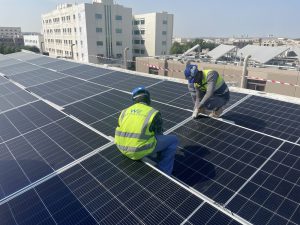
At Watts & Ergon, a DEWA-approved and ISO-certified solar EPC contractor, we specialize in designing and installing high-performance rooftop solar systems tailored specifically for warehouses, distribution centers, and industrial facilities across Dubai and the UAE.
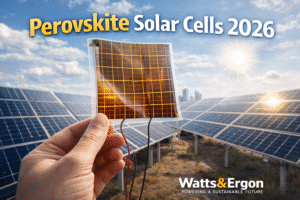
At Watts & Ergon, a DEWA-enrolled, ISO-certified solar EPC contractor, we design and install systems specifically engineered for UAE conditions. Here’s what actually works in 2026.