Electricity powers almost everything in our modern world, but not all electricity is the same. The two main types — Alternating Current (AC) and Direct Current (DC) — behave very differently and serve different purposes.
At Watts & Ergon,
, Dubai’s trusted solar energy partner, we work with both AC and DC systems every day. Understanding the difference helps our clients choose the right solutions for solar installations, energy efficiency, and cost savings.
What is DC Power (Direct Current)?
Direct Current flows in one direction only. The voltage remains constant.
- Produced by batteries, solar panels, fuel cells
- Used in electronics, LED lights, phones, laptops, electric vehicles
- Very efficient for short-distance transmission
What is AC Power (Alternating Current)?
Alternating Current periodically reverses direction. It changes direction 50 or 60 times per second (50/60 Hz).
- Supplied by power grids and generators
- Used in homes, offices, factories, and for long-distance transmission
- Easier and cheaper to step up or step down voltage using transformers
AC vs DC Power – Side by Side Comparison
| Feature |
AC (Alternating Current) |
DC (Direct Current) |
| Direction of Flow |
Changes direction periodically |
Flows in one direction only |
| Voltage Behavior |
Varies with time (sinusoidal wave) |
Constant voltage |
| Frequency |
50 Hz (Middle East) or 60 Hz |
0 Hz (No frequency) |
| Transmission Distance |
Excellent for long distances |
Better for short distances |
| Transformation |
Easy with transformers |
Difficult and expensive |
| Safety |
More dangerous (can cause muscle contraction) |
Generally safer at same voltage |
| Generation Source |
Power plants, grid |
Batteries, Solar PV panels |
| Common Applications |
Home appliances, lighting, motors |
Electronics, solar systems, EVs, data centers |
| Energy Loss |
Higher over very long distances |
Lower loss in short distances |
Key Advantages & Disadvantages
AC Power – Bold Points
- Best for long-distance transmission — used by all national power grids in the Middle East
- Easy to convert to different voltages
- Cheaper to produce at large scale
- Can cause more power loss due to reactance
DC Power – Bold Points
- Higher efficiency for solar photovoltaic systems
- No reactive power loss
- Ideal for battery storage and modern electronics
- More difficult to transmit over long distances without conversion
Important Fact for Solar Users:
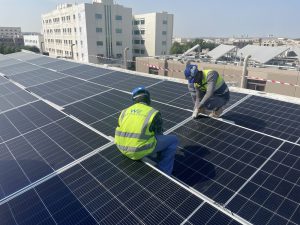
Solar panels naturally produce DC power. Inverters are used to convert this DC into AC so it can be used in homes or fed into the national grid.
Why This Matters in Solar Energy (Middle East Context)
- Solar panels generate DC power
- Most homes and businesses run on AC power
- Modern hybrid systems and battery storage work with both AC and DC
- Choosing the right inverter and system design can save 5–15% in energy losses
AC-DC in Everyday Life & Future Trends
With the rise of solar, batteries, and electric vehicles, DC power is becoming more important. Many new buildings and data centers are moving toward DC microgrids for higher efficiency.
Whether you need a complete solar system with the best inverters, hybrid AC-DC solutions, or expert advice on energy storage, Watts & Ergon,
delivers optimized, high-performance systems tailored for the UAE and Middle East conditions.